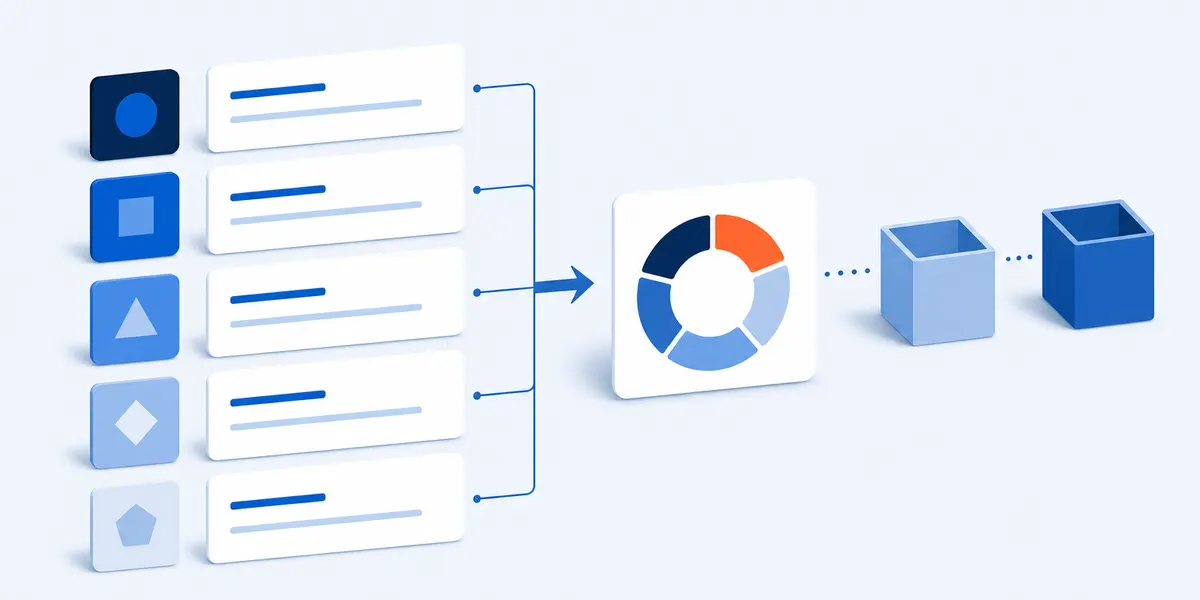
Voice of the Customer Survey Template
A voice of the customer survey is not one form. It is several listening posts running on different clocks, and this is the one that runs quarterly: a 13-question relationship survey, anonymous, on a single scale. Answer it below before you send it, then copy the questions or open the whole survey in the editor.
- 13questions
- About 4 minto complete
- Quarterlynot event-triggered
- No scoreread item by item
Which listening posts to run, and on what clock
A voice of the customer programme is several short surveys on different clocks, not one long one. Work out where your customer is standing, then read across to the clock.
| Where the customer is | What runs there | How often | Template |
|---|---|---|---|
| Three months in, and still using you | This relationship survey, all 13 questions | Quarterly, on one fixed month. | The template on this page |
| Has just finished an order, a booking or a delivery | One rating about that experience | Every time the event fires. | The customer satisfaction survey |
| Has just had a problem solved by your support team | A short survey about that one request | On close, capped per person. | The customer service survey |
| Is settled enough to have a view they would repeat to somebody else | The recommend question by itself, nothing else on the form | One wave a quarter, same wording. | The NPS survey |
| Wants to tell you something now, without waiting to be asked | A survey on a permanent link, wherever the experience ends | The link stays live; one list send a quarter. | The customer feedback survey |
| Is not your customer yet, or buys from someone else | A screened study of the wider market | Once a planning cycle. | The market research survey |
The clocks are the whole idea. Two kinds of survey are in use here. An event survey fires from something that just happened, is tied to that moment, and is short. A relationship survey goes out on a schedule and asks how things are across the whole relationship.[2] They are not two settings of one form. They answer to different clocks.
Start with two, not seven. Most teams can keep two of these running honestly. Take the quarterly one, because nothing else on the list tells you how the relationship is aging, and add the event survey that fires most often in your business. Add a third when the first two are being read.
The B2B row is a real fork, not a courtesy. When your customer is a company rather than a person, the unit stops being the respondent and becomes the account, because one unhappy account can be worth more than a hundred consumers.[8] That survey is identified, timed to the renewal, and signed by a person. This one is anonymous, quarterly, and signed by nobody.
Surveys are not the whole programme. A full one also reads online reviews, support tickets, interviews and recorded calls.[6][5] Those are not surveys, this page cannot ship them, and the survey is only one part of the work.[7]
What the quarterly survey asks, block by block
Thirteen statements on one 5-point agree scale. Four on how the relationship stands, two on the thing you sell, two on being kept in the picture, two on what they need next, two open boxes, and one closing rating.
One scale, top to bottom. Every rated question is a statement people agree or disagree with. A form that mixes four answer styles reads as paperwork; one scale reads as an instrument, and it lets someone answer the whole thing in about four minutes.
Four blocks, in the order people think. The first block asks about the pattern rather than the last purchase: expectations, consistency, direction and trust. The second asks whether the thing you sell still does the job and still feels worth the money. The third asks whether you talk to people between purchases. The fourth asks what they need next.
Where a customer needs survey fits
The fourth block is the needs block. Published needs question sets turn out to be whole-relationship lists with a future-needs section on the end.[9] That is this survey with block four moved to the front, so use it as one. What it does not cover is discovery: framing a problem before you have customers to ask is a different job and a different instrument.
Nobody is asked who they are. There is no name field and no email field, on purpose, because this wave is about candour rather than follow-up. All thirteen questions are already written and built into the free online survey maker, so open it, change any wording, and drop a block you cannot act on.
The 13 voice of the customer survey questions
Each question, the scale it uses, and what agreement or disagreement is actually telling you. Copy one block, copy the thirteen with the swap-in after them, or open the template and skip the typing.
How the relationship stands
Four statements about the pattern, not about the last thing that happened.
- What you offer has lived up to what I expected.The gap between what you promised and what arrived. Disagreement here alongside good answers below means the problem is your marketing, not your product.
- I get the same standard every time, not just on a good day.Consistency. A middling answer from someone who rates everything else highly means they have been let down at least once and remember it.
- It has got better over the time I have been a customer.Direction. This is the item that separates a business that is improving from one coasting on a good first impression.
- I trust you to do the right thing when something goes wrong.Whether a mistake gets forgiven. Low answers turn one bad week into a customer you never hear from again.
The thing you sell
Two statements about the product or service at the level of the whole relationship.
- It does the main thing I need it to do.Basic fit. Disagreement from a long-standing customer means they have been working around you for months without telling you.
- What I pay feels fair for what I get.Value, not price. People who find you expensive but worth it agree here. People who find you cheap and disappointing do not.
Kept in the picture
Two statements about whether you talk to people between purchases.
- When something changes, I hear about it from you first.Whether customers learn about your changes from you or from an error message.
- When I have told you something, it has made a difference.The item that predicts your next response rate. When it falls, people have decided that answering you is pointless.
What they need next
The needs block: the job they first came to you for, and the one you do not do yet.
- What I first came to you for is still what I need most.Whether the job has moved. Disagreement is not a complaint. It is notice that your best customers are drifting towards a different problem.
- There is something I need that you do not do yet.Agreement is a to-do list, not a bad mark. Count it, then read question 12 from the people who agreed.
In their words, then the close
Two open boxes sit before the end, because asking for writing last is how you lose it. The survey closes on a rating.
- What made you stay with us this year?The reason they are still here. Answers name the one thing you must not break.
- What is the one thing you need from us that you do not get now?Pairs with question 10. Agreement there with nothing written here means you have a gap and no description of it.
- You are heading in a direction that works for me.The forward-looking item, and the one to watch across waves. It falls before the others do.
Swap-in: internal voice of the customer questions
For a team that serves other teams. Replace the first two blocks with these four and keep the rest of the survey as it is.
- The team I depend on gives me what I need to do my own job.Whether the internal service actually unblocks anyone.
- I know who to ask, and I do not have to chase.Findability and chasing, which is where most internal frustration lives.
- Changes on their side reach me before they reach my work.Advance notice. This is the most common internal complaint of the four.
- What I ask for is treated as work, not as a favour.Standing. Agreement means the relationship survives without a personal favour.
Three questions are missing on purpose. There is no 0 to 10 recommend item here, no satisfaction rating of a single experience, and no scored effort question. Each of those is a whole survey somewhere in the schedule above. The next section is why they cannot also live in this one.
One survey per number: why the three do not share a form
The recommend question, the satisfaction rating and the effort question all turn up inside the published question banks on this subject,[2][4] which quietly hands you one form carrying all three at once. Here is what that costs.
The recommend question stops being comparable. It is read as one number for the whole relationship and set against its own history wave after wave. Bury it at question nine and you change who reaches it: only the patient. The number moves, and you cannot tell whether your customers changed or your form did.
A satisfaction rating goes stale. It is about one experience and has to arrive while that experience is fresh. On a quarterly clock it turns up weeks late and becomes a general mood rating wearing a specific name.
The effort question loses its subject. It asks how hard one task was. Put it in a form with no task in it and people answer about your company in general, which is not what the question means or how it is read.
The nearest published advice stops one step short. It tells you to send the three at different times and analyse them separately,[4] which is right, and then hands over a single long bank that anyone would naturally build as one form. Our version is a step earlier: do not build the form. Run them side by side, on their own clocks, and keep all three numbers usable.
The price of separating them is one more send. The price of stacking them is that every number stops being comparable to its own past, which was the only thing any of them was for.
Standing up the schedule
Five decisions that only a quarterly relationship survey has to make. Everything a send has in common with every other send is in the survey research guide.
Choose the month, then never move it
Pick one calendar month per quarter and keep it. A wave that slides by three weeks changes who is in it and hides whatever moved.
Send to the list, never to a trigger
Everyone who has been a customer for a full quarter goes in. No segments, no exclusions, and no leaving out the people who complained.
Leave the event surveys running while this one is open
They answer different questions on different clocks. Pausing them to protect this wave costs you the answers that were arriving anyway.
Tag every written answer to a block before anyone sees a chart
Ten minutes of tagging turns a pile of comments into counts you can set beside the ratings.
Name the person who answers people back
Our judgement, not a finding: a survey that never writes back is one people quietly stop filling in. Put that name on the closing screen.
Reading a wave: there is no score, and someone is missing
This is the honest part. A quarterly relationship survey is the easiest survey in the world to read too kindly.
There is no score, and there should not be. Averaging thirteen unrelated statements gives a number that moves for reasons you cannot trace back to anything. Read the items one at a time, and read the direction across three waves rather than the gap between two. The single comparable numbers live on the other pages in the schedule, which is where they work.
The people who left are not on the list. Every wave goes to current customers, so the unhappiest ones have already gone. Run this honestly for two years and it gets steadily more flattering while the business gets worse. Nothing inside the survey fixes that. You fix it by treating rising ratings on a shrinking list as a warning rather than a win.
A short list moves on one person. With forty answers, one person shifting two points on one item is visible on the chart. Below about thirty answers, report the written comments and leave the ratings out of the slide.
Anonymous means you cannot ring anyone back. Nobody is asked for a name or an email, and the answers are read only by whoever owns the survey. So a furious written answer arrives with no one attached to it, and that is the price of the candour this wave buys.
Voice of the customer survey FAQ
What is a voice of the customer survey?
It is a survey built to be acted on. Answers get labelled, the labels counted, each count sent to whoever owns that part of the business, and the people who wrote in hear back.[3] Most people arrive looking for one form. There is no single form. There is a set of listening posts on different clocks, and the one on this page is the quarterly relationship survey.
How often should you run one?
The relationship survey runs quarterly, in a month you fix and keep. The event-triggered surveys run every time their event happens, which is what makes them a different survey rather than a section of this one.[4] Published guidance on cadence varies, and the rule worth keeping is that a wave you move is a wave you cannot compare.
Is a customer needs survey the same thing?
Mostly, under another name. The published needs question sets are whole-relationship lists with a future-needs section on the end,[9] which is this survey with the fourth block moved to the front. The exception is discovery, before you have customers to ask: framing a problem and sizing a market is a different instrument.
How is this different from collecting customer feedback all year?
A standing intake is open all the time, anyone can reach it, and it gets sorted after the fact. This is a wave: a fixed list, a fixed month, the same thirteen questions every time, so one quarter can be set beside the last. Most businesses end up running both.
Do you need software to run a voice of the customer programme?
No. A spreadsheet and a shared inbox will run one for a long time. What software buys is text analysis, once written answers arrive faster than one person can read them, and dashboards for people who will not open a spreadsheet. Neither writes better questions, and neither is what gets an answer acted on.
A listening programme runs on a cadence and reads a population over time. A departure is not a cadence, it is a single moment with a short window, so the cancellation survey questions are triggered by the cancel action rather than by the calendar.
A listening programme runs on a clock and collects opinion. A profile collects fact, once a planning cycle, and the customer profile survey deliberately ships no rating scale at all.
Methods and sources
What this template is based on
The relationship-versus-event split follows the published definition of the two survey types[2], the cadence in the schedule follows published practitioner guidance[3][4][5], and the needs block follows the future-needs section of a published needs question set[9].
Question licensing
Voice of the customer is a discipline rather than a licensed instrument, so there is nothing here to license and every question is ours.[10] Net Promoter, NPS and Net Promoter Score are marks of Bain and Company, NICE Systems and Fred Reichheld; the recommend question is named here and never reproduced.[1]
Limits and disclosure
No benchmark is offered. Published question-count and length advice for this survey disagrees by a factor of five and none of it carries data.[2][4]
SuperSurvey makes the editor this template opens in, and the questions are free to copy, edit and send anywhere.
References
- Bain and Company. Measuring your Net Promoter Score. Net Promoter System. netpromotersystem.com
- Zonka Feedback. Voice of Customer Surveys. Zonka Feedback blog. zonkafeedback.com
- SupportBee. Voice of the Customer Survey: 25 Questions. SupportBee blog. supportbee.com
- Checkbox. Voice of the Customer Survey Questions. Checkbox blog. checkbox.com
- SurveyMonkey. Voice of the Customer. SurveyMonkey Learn. surveymonkey.com
- Qualtrics. What is Voice of the Customer (VoC)? Qualtrics Experience Management. qualtrics.com
- Mopinion. Voice of the Customer Survey. Mopinion. mopinion.com
- CustomerGauge. Voice of Customer Survey. CustomerGauge blog. customergauge.com
- SmartSurvey. 36 Customer Needs Survey Questions. SmartSurvey sample questions. smartsurvey.co.uk
- Voice of the customer. Wikipedia. en.wikipedia.org
Pick the month and send the first wave
Thirteen questions, about four minutes, no name asked. Open it in the editor, change any wording, and choose the month you are going to keep.
Use this template