View/Export Results
Manage Existing Surveys
Create/Copy Multiple Surveys
Collaborate with Team Members
Sign inSign in with Facebook
Sign inSign in with Google

50+ Essential Delivery Survey Questions (Free Template)

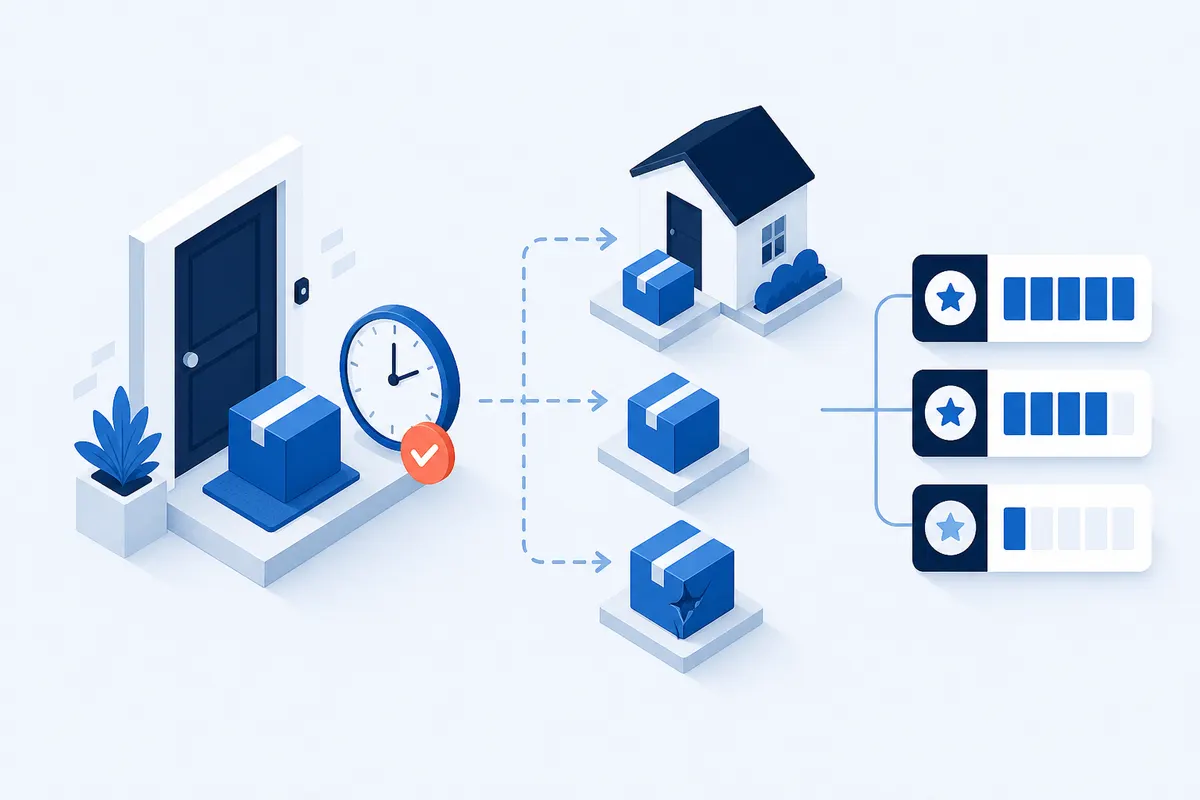
Use this delivery survey to measure what your customers actually experienced at the door: on-time performance, order accuracy, condition on arrival, tracking clarity, and handoff quality. The template includes a short core flow for normal deliveries plus an exception module that only appears when something went wrong, so you can pinpoint root causes and route fixes to ops or support.

8
Questions
6 min
Completion Time
4.9
☆☆☆☆☆
4.4k+
Uses
Use This Template Copy & Edit
Please rate your overall satisfaction with your recent delivery.
1
2
3
4
5
Very Dissatisfied Very Satisfied
The delivery arrived within the expected timeframe.
1
2
3
4
5
Strongly Disagree Strongly Agree
The items were in good condition when they arrived.
1
2
3
4
5
Strongly Disagree Strongly Agree
The delivery tracking and communication met my expectations.
1
2
3
4
5
Strongly Disagree Strongly Agree
I would recommend our delivery service to others.
1
2
3
4
5
Strongly Disagree Strongly Agree
What suggestions do you have for improving our delivery service?
What is your age range?
Under 18
18-34
35-54
55-64
65+
What is your gender?
Male
Female
Non-binary
Prefer not to say
Other

Trusted by 5000+ Brands

Trusted by Red Bull, Yale, Apple, Harvard, Shopify and more

Delivery survey question blocks (normal vs exception deliveries)

  • Goal: Pinpoint which part of your delivery experience drives complaints, refunds, and repeat contact.
  • Default: A short core flow (6-10 questions) for every delivered order, plus an exception module that only appears if the delivery was late, damaged, missing, or missed.
  • Edit this template: Use a 5-point Likert scale for rating items, add your promised window wording, and set branch rules for late/damaged/missing/missed deliveries.
Scale anchors (recommended for consistency)

Label endpoints so customers interpret ratings consistently (and your trends are comparable): for agreement items use 1=Strongly disagree and 5=Strongly agree; for CSAT use 1=Very dissatisfied and 5=Very satisfied; for CES use 1=Very difficult and 5=Very easy.

Core block (ask everyone)

"Was your delivery completed within the promised delivery window?"

Why it matters: This is the cleanest operational outcome. It ties directly to route planning, carrier performance, and window promises.

When to use: Include in every run. Use as the trigger for your exception module when the answer is "No."

Yes/No Segment by: carrier, region, promised window, delivery type

"How satisfied were you with the delivery experience overall?"

Why it matters: You need one headline score to trend weekly and to prioritize fixes when volumes spike.

When to use: Include in every run. Use as your primary delivery CSAT (separate from product satisfaction).

CSAT (1-5; 1=Very dissatisfied, 5=Very satisfied) Segment by: carrier, route, shift, order size/value

"Which of the following best describes your delivery experience?"

Why it matters: A forced-choice reason turns a score into an ops queue. It prevents you from guessing based on comments.

When to use: Ask right after overall CSAT. Use options that match your fix owners.

Multiple choice Options: On time, Late, Damaged, Missing items, Tracking/updates, Handoff/driver, Other

"The tracking link and delivery updates were clear and accurate."

Why it matters: Clear updates reduce WISMO tickets and set expectations when ETAs move.

When to use: Include when you provide tracking, SMS updates, or push notifications.

Likert (1-5; 1=Strongly disagree, 5=Strongly agree) Segment by: notification type, carrier, region

"My order arrived complete (nothing missing)."

Why it matters: Missing items drive refunds and repeat contacts. This points to pick/pack, staging, and handoff controls.

When to use: Include for any multi-item order, grocery, or restaurant delivery with modifiers.

Likert (1-5; 1=Strongly disagree, 5=Strongly agree) Segment by: fulfillment location, shift, order complexity

"My order arrived in good condition."

Why it matters: Damage is often packaging, handling, or route-specific. You need a consistent signal that you can trend by carrier and lane.

When to use: Include for parcel, fragile goods, or food where presentation matters.

Likert (1-5; 1=Strongly disagree, 5=Strongly agree) Segment by: packaging type, carrier, vehicle type

"The driver/courier was professional and respectful."

Why it matters: Handoff behavior is a controllable coaching lever. It also explains low scores even when the delivery was on time.

When to use: Include when customers interact with a courier or when drivers enter buildings.

Likert (1-5; 1=Strongly disagree, 5=Strongly agree) Segment by: carrier, route, delivery setting (house vs apartment)

"Where was your order left?"

Why it matters: Mis-deliveries and theft often show up as "missing". A location question helps you validate proof-of-delivery and photo coverage.

When to use: Include if you support contactless drop-off or photo proof-of-delivery.

Multiple choice Options: Front door, Mailroom/locker, Reception, Neighbor, Other

"What is one thing we could improve about delivery?"

Why it matters: Comments explain the "why" behind late, damage, or communication issues. They also surface edge cases you did not anticipate.

When to use: Put at the end of the core flow. Keep it optional.

Open text Collect with: order ID, carrier, region, promised window

Exception module (only if late/damaged/missing/missed)

Map your diagnostic questions to what you can fix: reliability (on-time + complete), responsiveness (update speed), assurance/empathy (handoff behavior), and tangibles (package condition). This aligns with SERVQUAL-style dimensions commonly used in logistics service quality measurement (see: logistics service quality and SERVQUAL dimensions).

"What went wrong with this delivery?"

Why it matters: You need a root-cause label that routes to the right team (ops vs support vs carrier claims).

When to use: Show if on-time = "No" or if condition/completeness scores are low.

Multiple choice Options: Late, Missed attempt, Damaged, Missing items, Wrong address/drop-off spot, No updates, Other

"How late was the delivery compared to the promised window?"

Why it matters: A 20-minute slip and a 2-day slip should not land in the same ops bucket.

When to use: Show only if the customer selected "Late" (or on-time = "No").

Multiple choice Options: <30 min, 30-60 min, 1-3 hours, Same day, 1+ days

"Did you receive a proactive update about the delay before the promised time?"

Why it matters: Proactive updates reduce frustration even when you cannot prevent a delay.

When to use: Show for late or missed deliveries. Use it to improve notification triggers and ETA rules.

Yes/No Segment by: notification channel, carrier, region

"How easy was it to report the problem or get help?"

Why it matters: This is effort, not satisfaction. It tells you whether the exception journey creates unnecessary work.

When to use: Show only if something went wrong, or if the customer contacted support.

CES (1-5; 1=Very difficult, 5=Very easy) Segment by: contact channel, case outcome, carrier

"What outcome did you get for this issue?"

Why it matters: Outcomes drive repeat purchase and complaint volume. This question links delivery failures to cost (refunds/replacements).

When to use: Show when the customer reports an issue or low CSAT.

Multiple choice Options: Delivered late, Replacement sent, Refund issued, Pickup/return scheduled, Still unresolved

Copy-ready question bank (add/remove based on your model)

  • Timeliness and promises
    • "How accurate was the estimated delivery time (ETA)?"
    • "The promised delivery window was realistic."
    • "The delivery arrived at a convenient time."
    • "Would you prefer a narrower delivery window, even if it costs more?"
    • "Did you have the option to choose a delivery window?"
    • "If you chose a window, did we honor it?"
    • "Did you receive updates when the ETA changed?"
    • "How often did you receive delivery updates?"
  • Accuracy and completeness
    • "All items I ordered were delivered."
    • "The correct variants/options were delivered (size, color, flavor)."
    • "The quantity delivered matched what I ordered."
    • "If items were substituted, the substitution was acceptable."
    • "Were you informed about any substitutions before delivery?"
    • "How satisfied were you with item availability?"
    • "If something was missing, which item(s) were missing?"
    • "If something was wrong, which item(s) were incorrect?"
  • Condition on arrival
    • "The outer packaging was not damaged."
    • "The product(s) inside were not damaged."
    • "The package appeared to be handled with care."
    • "If the order was food, the packaging seals were intact."
    • "If the order was food, the temperature was acceptable."
    • "If the order was fragile, the protective packaging was sufficient."
    • "Did you notice any signs of tampering?"
    • "If damaged, what type of damage occurred?"
  • Tracking and communication
    • "The tracking status matched what actually happened."
    • "It was easy to find the tracking link."
    • "Delivery instructions were visible to the driver/courier."
    • "The driver/courier followed my delivery instructions."
    • "I received enough notice before the driver arrived."
    • "The delivery confirmation (photo/signature) was clear."
    • "Did you receive a delivery confirmation message?"
    • "Which channel did you receive updates in?"
  • Handoff and driver experience
    • "The driver/courier was easy to communicate with."
    • "The driver/courier treated my property with respect."
    • "The driver/courier delivered to the correct location."
    • "The driver/courier contacted me when needed."
    • "The delivery felt safe and secure."
    • "Did you have to go somewhere else to pick up the order?"
    • "If a signature was required, the process was smooth."
    • "If you met the driver, how would you rate the handoff?"
  • Exception and recovery (branch only)
    • "What do you think caused the issue?"
    • "How satisfied were you with how we handled the issue?"
    • "How long did it take to resolve the issue?"
    • "Did you have to contact support more than once?"
    • "Did you receive a clear next step after reporting the issue?"
    • "Was the resolution fair?"
    • "Did the issue change whether you would order again?"
    • "What should we do differently next time?"

Quick setup:

  • Keep the core flow to 6-10 questions, then branch for exceptions.
  • Replace "promised delivery window" with your exact promise (date, time range, SLA).
  • Add hidden fields: order ID, delivery ID, carrier, region, promised window, delivery type.
  • Route exception answers to ops (late/damage) vs support (resolution outcomes).

Choose the right delivery metric: CSAT vs NPS vs CES (recommended combo inside)

  • Goal: Pick a metric that drives a concrete decision (alerts, coaching, carrier claims, or product promise changes).
  • Default: Delivery CSAT + a forced-choice reason for every delivery, then CES only inside the exception flow.
  • Edit this template: Keep NPS optional for quarterly loyalty tracking, not for daily delivery ops.
Metric Best use for delivery Pros Watch-outs Action it should trigger
CSAT (1-5) Day-to-day delivery performance for each order Fast to answer; easy to trend by carrier/region/window; works with branching Needs a reason code to be diagnostic Ops scorecard, weekly carrier review, alerts on dips
NPS (0-10) Higher-level loyalty signal across the whole brand experience Comparable across time; useful for exec reporting Not specific to delivery; weak for root-cause without many follow-ups Strategic initiatives (promise design, experience investment)
CES (1-5) Exception handling effort (reschedule, report missing, get refund/replacement) Pinpoints friction in the recovery process; ties to contact volume Confusing if asked after a normal delivery with no work required Fix self-serve flows, reduce transfers, tighten case ownership
Make scores comparable across time

Use labeled endpoints on your scales (for example: CSAT 1=Very dissatisfied, 5=Very satisfied; CES 1=Very difficult, 5=Very easy) and keep wording stable between survey waves to reduce measurement noise.

Recommended combo for most delivery teams

  • Always: Overall delivery CSAT + forced-choice reason (Late, Damaged, Missing items, Tracking/updates, Handoff/driver).
  • Branch only: CES questions when the customer had to do work (report a problem, reschedule, request a refund/replacement).
  • Optional: NPS monthly or quarterly if you also want a loyalty headline.

Interpretation rule that keeps you honest: trend on-time performance next to CSAT, since on-time delivery is linked to satisfaction and loyalty outcomes (see The Effect of On-Time Delivery on Customer Satisfaction and Loyalty).

Quick setup:

  • Make CSAT your main weekly KPI, then break it down by reason code.
  • Use CES only in exception flows where the customer took extra steps.
  • If you keep NPS, do not mix it into the same short post-delivery survey.

Send timing, channels, and targeting rules for delivery feedback

  1. Goal, default, and the exact trigger
    • Goal: Collect fresh, order-linked feedback without spamming repeat customers.
    • Default (starter approach): Trigger 1-24 hours after delivery confirmation for normal deliveries; adjust after you review your baseline response rate and complaint timing.
    • Edit this template: Add a separate trigger for exceptions and suppress sends during unresolved disputes.
  2. Send after delivery confirmation (not after shipment)

    Trigger from a reliable event: "Delivered" scan, photo proof-of-delivery, or your internal delivery completion status. Send quickly so customers remember details like the drop-off spot and packaging condition.

  3. Use an exception trigger for late/damaged/missed orders

    Send the exception module when the case is resolved or the status is stable (replacement shipped, refund approved, delivery rescheduled). Avoid surveying mid-dispute because answers swing with the last message.

  4. Pick channel based on the answer depth you need

    SMS: Best for 3-6 questions (on-time, CSAT, reason code). You will get faster responses.

    Email: Best when you need more detail (damage types, missing items list, open text) or you want photos via your support flow.

  5. Set targeting rules and a frequency cap

    Apply consistent sampling rules so results reflect reality, not just your happiest customers. Do not only survey successful deliveries.

    • Frequency cap (internal starter target): 1 invite per customer every 14-30 days; adjust after your baseline and purchase cadence (for example, subscriptions may need a longer cap).
    • Suppression: Skip if an open support ticket exists for the same order.
    • Inclusion: Include failed/returned deliveries with the exception flow.

    Because non-responders are not random, track who you invite and compare basic outcomes (late rate, carrier, region) for responders vs non-responders (see Leveraging non-respondent data in customer satisfaction modeling).

  6. Attach the metadata you will need later

    Prefill hidden fields so you can segment without asking customers to remember details. Capture: order ID, delivery ID, carrier, service level, region, route/shift (if you have it), promised window, and delivery type (parcel, food, scheduled, B2B).

  7. QA the flow like an operator

    Test four scenarios end-to-end: on-time success, late delivery, damaged item, and missing item. Confirm the branch logic, the suppression rules, and the data fields before you scale.

Quick setup:

  • Set the normal trigger to 1-24 hours after delivery confirmation (starter approach; adjust after baseline).
  • Create a second trigger for exceptions after resolution or stable status.
  • Add frequency caps and suppression for open tickets.
  • Pass through order/delivery metadata as hidden fields.

Analysis and action playbook: scorecards, alerts, and closed-loop follow-up

  • Goal: Turn delivery feedback into an ops routine (weekly fixes) and a support routine (fast recovery for low scores).
  • Default: One scorecard, a few required segments, and alert thresholds that route issues to an owner.
  • Edit this template: Standardize reason codes, add tags for themes, and define what happens after a low CSAT.
  • Build a delivery scorecard: Track CSAT, on-time rate (promised vs actual), completeness, condition, tracking clarity, and handoff professionalism. Review weekly, not quarterly.
  • Segment before you debate: Cut results by carrier, region, delivery type, promised window, and fulfillment location. Always show volume next to scores.
  • Set alerts that trigger action: Flag week-over-week drops (internal starter target: CSAT down ~0.4+ on a 1-5 scale; adjust after your baseline, sample size, and normal variance) or spikes in "Late" reason codes. Route late/damage spikes to ops; route "resolution still unresolved" to support leadership.
  • Tag comments into themes: Use open-ended questions for "what happened" and "what should we change." Then follow a simple loop: scan 50 comments, create 8-12 tags, code the full set, quantify by carrier/region, and assign fixes (see Analyzing free-text survey responses: an accessible strategy).
  • Close the loop on low CSAT: Follow up on very low scores (for example, 1-2 on a 1-5 CSAT scale). Internal starter target: follow up within 24-48 hours; adjust after your baseline and staffing model. Confirm outcome (refund/replacement), file carrier claims when needed, and fix address/instructions issues in the customer profile.
  • Run a weekly ops review: Bring three views: reason-code trend, top negative themes, and worst segments by volume. End the meeting with 1-3 changes you will ship (packaging change, notification rule, carrier lane change, driver coaching).

Quick setup:

  • Pick 5-7 scorecard metrics and trend them weekly.
  • Make carrier, region, promised window, and delivery type required segments.
  • Create alert rules for spikes in "Late", "Damaged", and "Missing" reason codes (starter thresholds; tune after baseline).
  • Define a follow-up workflow for low CSAT with timelines that match your staffing (starter target: 24-48 hours; adjust after baseline).

Common delivery survey pitfalls (and how to avoid them)

Pitfall: Only surveying successful deliveries

Fix: Include late/missed/damaged/returned orders and use a branched exception module. If you only survey "good" outcomes, your scores drift upward and you miss root causes; this is a common satisfaction-survey bias pattern (see Bias in patient satisfaction surveys for an overview of how response and sampling bias can distort results).

Pitfall: Mixing product satisfaction with delivery satisfaction

Fix: Keep delivery questions strictly about timeliness, condition, tracking, and handoff. Ask product satisfaction elsewhere, or you will blame delivery for product issues (and vice versa).

Pitfall: A long survey with no branching

Fix: Keep a 6-10 question core, then add 3-6 exception follow-ups only when something went wrong. Length kills completion and increases straight-lining.

Pitfall: Leading or blamey wording

Fix: Write neutrally and focus on observable events ("Was it on time?", "Was anything missing?"). Leading wording increases response bias and makes teams argue about the data instead of fixing issues.

Pitfall: No way to link responses to ops data

Fix: Always capture order ID and delivery ID (hidden/prefilled). Add carrier, region, promised window, and delivery type so you can isolate one lane or one provider quickly.

Quick setup:

  • Separate delivery CSAT from product satisfaction questions.
  • Use branch logic for exceptions instead of asking everyone everything.
  • Keep wording neutral and event-based (on-time, missing, damaged, updates).
  • Attach order/delivery IDs and carrier/region/window metadata.

Frequently Asked Questions

When should I send a post-delivery survey?

Send the normal delivery survey 1-24 hours after delivery confirmation so details are still fresh. For late, damaged, or missed deliveries, use a separate exception trigger after resolution (or when status is stable) and suppress invites while an open ticket is active. Add a frequency cap so repeat customers do not get invited too often.

Should I use CSAT, NPS, or CES for delivery feedback?

Use CSAT as your primary delivery metric because it trends well by carrier, region, and promised window. Add a forced-choice reason code (Late, Damaged, Missing, Tracking/updates, Handoff) so teams know what to fix. Use CES only in exception flows where the customer had to do work (report an issue, reschedule, refund/replacement), and keep NPS optional for higher-level loyalty tracking.

How many questions should a delivery survey have?

Keep the standard delivery survey to 6-10 questions so customers finish it quickly. Add 3-6 branched follow-ups for exceptions (late/damaged/missing/missed) because diagnostics differ from successful deliveries. Prioritize questions that map to operational levers: on-time window, completeness, condition, tracking, and handoff.

How do I customize the template for parcel vs food vs scheduled/B2B deliveries?

For parcel, add packaging damage detail, proof-of-delivery clarity, and drop-off location options (mailroom/locker/reception). For food, add temperature, seal integrity, freshness, and handoff timing at the door. For scheduled, white-glove, or B2B, emphasize time-window adherence, appointment coordination, receiver/dock coordination, and delivery documentation.

How do I connect survey responses to carrier, route, and delivery performance data?

Prefill hidden fields like order ID, delivery ID, carrier, promised window, region, and delivery type on every invite. That lets you segment scores and comments to find patterns like one carrier in one region driving late deliveries. Keep the customer-facing questions short and let your metadata do the heavy lifting.

Should I survey failed or returned deliveries?

Yes. Failed and returned deliveries often contain the highest-value root-cause signal, so excluding them hides your biggest problems. Use an exception flow with tailored questions (what happened, communication quality, and resolution outcome) and keep wording neutral to avoid blame.

FREE TO START -- NO CREDIT CARD REQUIRED

Create Your 50+ Essential Delivery Survey Questions (Free Template) Now.

Start Building ➔