View/Export Results
Manage Existing Surveys
Create/Copy Multiple Surveys
Collaborate with Team Members
Sign inSign in with Facebook
Sign inSign in with Google

15 customer profile survey questions, and four to leave out

A profile survey is the only one where every question is about the person answering and none is about you. That is what makes it worth sending and what makes it identifying. Here are the fifteen, and the four missing on purpose.

  • 15questions
  • About 4 minto answer
  • 5blocks you can cut
  • 0rating scales
Customer Profile Survey · answer to move through it
Use this template
Question 1 of 15 Which kind of buyer
Which of these best describes how you buy from [YOUR ORGANISATION]?
For myself or my household
For a business or organisation
On behalf of someone else
Question 2 of 15 Which kind of buyer
How long have you been buying from us?
This is my first order
Less than 6 months
6 to 12 months
1 to 3 years
More than 3 years
Question 3 of 15 Which kind of buyer
When did you last buy from us?
Within the last month
1 to 3 months ago
3 to 12 months ago
More than a year ago
I have not bought anything yet
Question 4 of 15 What you came for
What were you trying to get done when you first came to us?
Question 5 of 15 What you came for
What was happening just before you started looking?
Something broke or ran out
Something changed at home or at work
I had a deadline or an event coming up
I saw or read something that gave me the idea
Nothing in particular
Question 6 of 15 What you came for
What were you doing about it before you found us?
Nothing, I was putting up with it
Using a competing product or service
A workaround of my own
Someone else was doing it for me
I cannot remember
Question 7 of 15 How you buy
Which way did you place your most recent order?
On the website
In a shop or in person
In a mobile app
By phone
By email or in writing
Through a reseller
Question 8 of 15 How you buy
How often do you buy from us?
This was a one off
A few times a year
About once a month
Every week or more often
On a subscription or contract
Question 9 of 15 How you buy
Roughly how much do you spend with us in a year?
Under 100
100 to 499
500 to 1,999
2,000 to 9,999
10,000 or more
Rather not say
Question 10 of 15 How you buy
Who else is involved in deciding whether to buy?
Nobody, it is my decision alone
A partner or someone at home
A manager or a budget holder
A team or a committee
A purchasing or procurement team
An outside adviser
Question 11 of 15 Where to reach you
How did you first hear about us?
A search engine
A recommendation
Social media
An advert
A review or comparison site
An event or a shop
I cannot remember
Question 12 of 15 Where to reach you
Where do you look when you are working out what to buy in this category?
Search engines
Review and comparison sites
Social media or video
Newsletters or trade press
People I know
The seller's own website
I do not research it
Question 13 of 15 Where to reach you
If we had something worth telling you about, where would you rather hear it?
Email
Text message
In the app or on the website
Social media
Post
Nowhere, only about my own orders
Question 14 of 15 The minimum about you
Which age band are you in?
Under 25
25 to 34
35 to 44
45 to 54
55 to 64
65 or older
Rather not say
Question 15 of 15 The minimum about you
Which country are you answering from?

The 15 customer profile survey questions, block by block

Five blocks, in the order you would send them. Cut a whole block and the survey still reads.

Plain text, one question per line, with the answer scale.

Which kind of buyer you are

These three decide how everything after them reads. Split by question 1 first: a household buyer and a purchasing team are two populations sharing one form.

  1. Which of these best describes how you buy from [YOUR ORGANISATION]?Single choiceThe screener, first because it changes which later questions matter. A business buyer answers question 10 completely differently.
  2. How long have you been buying from us?Single choiceTenure as a band, not a date. With question 3 it separates a customer you still have from one you used to have.
  3. When did you last buy from us?Single choiceRecency. With question 2 it finds the people your records still count as customers who have quietly stopped.

What you came for

The half no purchase record holds. Your CRM knows what somebody bought; only they know what set it off.

  1. What were you trying to get done when you first came to us?Open textThe one open box, early while attention is highest. The words people use here are the words to put in the next question set.
  2. What was happening just before you started looking?Single choiceThe trigger, as a single choice so it can be counted. The last option is there so nobody invents an event that did not happen.
  3. What were you doing about it before you found us?Single choiceThe alternative. Anyone putting up with it was not taken from a competitor, which changes where the next customer comes from.

How you buy

Behaviour rather than opinion. This is the block to keep if you cut the survey in half.

  1. Which way did you place your most recent order?Single choiceChannel, asked about the last order: a general answer describes a habit, the last order describes a fact.
  2. How often do you buy from us?Single choiceFrequency in bands wide enough that nobody has to count. Crossed with question 9 it gives you value.
  3. Roughly how much do you spend with us in a year?Single choiceSpend with you, not household income. Put your own currency and bands in, and keep the last option: a refusal you can see beats a number somebody made up.
  4. Who else is involved in deciding whether to buy?Select all that applyThe buying unit. For anyone who chose the business option at question 1, it decides who your marketing is addressed to.

Where to reach you

The block that turns a profile into a media plan. Analytics only shows the channels you already use; these three can name one you do not.

  1. How did you first hear about us?Single choiceFirst contact as the customer remembers it. It will not match your attribution model and is not meant to: this is the story they repeat.
  2. Where do you look when you are working out what to buy in this category?Select all that applyWhere the research happens. Tick-all, because the honest answer is a list.
  3. If we had something worth telling you about, where would you rather hear it?Single choicePreferred channel, with a last option that lets somebody say no. A stated preference beats an assumption.

The minimum about you

Both last, and both as coarse as they can be and still be useful. What is missing here is missing on purpose, and the next section says why.

  1. Which age band are you in?Single choiceAn age band, never a date of birth. Bands this wide read fine in a cross-tab and single nobody out.[1]
  2. Which country are you answering from?Open text, optionalA country, not a postcode. Optional by design: if you already hold a delivery address, do not ask for it twice.

Three placeholders to replace before you send. [YOUR ORGANISATION] in questions 1 and 2, your currency and bands in question 9, the category wording in question 12. All fifteen are written for this page: copy them, edit them, translate them.

There is no score and nothing to average. Fourteen answers are categories and the fifteenth is a sentence, so the output is counts and cross-tabs. They are already built in the free questionnaire creator: open them, change the words, send one link.

The four questions that are missing, and when to add one back

Gender, race and ethnicity, household income and a postcode open most lists of profiling questions. None is in the fifteen. Here is the test for adding one, and the wording if you pass it.

The test is one sentence: name what you would do differently at each answer. If you can say "we would stock a different size range", ask it. If the honest answer is that it would be interesting to know, leave it out. A field you cannot act on still has to be stored and explained, and it costs you answers you did need.

Precision is the part people get wrong, not the subject. The same three facts identify almost everybody or almost nobody depending on how finely you ask. On the 2000 US census, gender with a ZIP code and a full date of birth singled out 63.3 percent of Americans; with a year of birth instead, 0.2 percent.[1] That is why question 14 is a band and question 15 is a country.

ZIP code + full date of birth63.3%County + full date of birth14.8%ZIP code + year and month4.2%ZIP code + year of birth only0.2% Share of the US population uniquely identified, with gender, 2000 census
The same three fields, asked four ways. Gender, a location and a birth date, on 2000 US census data.[1]

The four to add only if you can name the decision

ADD ONE OF THESE ONLY IF YOU CAN NAME THE DECISION IT CHANGES.

1. GENDER. Add only if what you sell, size or say differs by it.
   What is your gender?
     Woman  /  Man  /  Non-binary  /  Prefer to self-describe: ______  /  Prefer not to say

2. RACE AND ETHNICITY. Add only if you will act on the answer, and use a published
   standard, not your own list. The US federal standard is one combined question with
   seven minimum categories, and people pick as many as apply.
   Which of these describe you? Select all that apply.
     American Indian or Alaska Native  /  Asian  /  Black or African American  /
     Hispanic or Latino  /  Middle Eastern or North African  /
     Native Hawaiian or Pacific Islander  /  White  /  Prefer not to say
   In the UK and the EU this is a special category of personal data and needs more than
   a tick box behind it. In the UK, use the census categories for your own nation.

3. HOUSEHOLD INCOME. Add only if you price or segment by it. Question 9 above asks what
   people spend with you, which is what most sellers wanted.
   Which band is your total household income in, before tax?
     [six bands you set]  /  Prefer not to say
   Put one line above it saying why you are asking.

4. POSTCODE OR ZIP CODE. Add only if you ship, have territories or open sites. Otherwise
   ask the country, which question 15 already does.
   What is the first part of your postcode, or the first three digits of your ZIP code?

And never ask for a full date of birth. An age band answers the same question, and a
birth date does not come back off the record once it is on it.

Race and ethnicity is the one to get right or leave alone. In the United States the federal standard is one combined question with seven minimum categories, picking as many as apply.[4] Using it lets your answers be read against national figures rather than only against themselves. In the UK and the EU the same answer is a special category of personal data, named in the regulation alongside health and religious belief, and it needs a legal condition rather than a tick box.[5] Wording the options is covered in the demographic answer options guide.

Do not promise anonymity on a profiling survey. It is the one survey where the questions and the promise contradict each other. Put one line at the top saying who will read the answers and why, and leave the name and email fields off unless you need to write back. That is a smaller promise that survives being checked.

Which survey do you actually want?

Six things people are trying to find out when they land here. Only one of them is this survey.

What you are trying to find outThe survey that answers itWhy it is a different survey
Who your customers are, what set them off, how they buy and where to reach themThe template on this pageEvery question is about the respondent.
Whether they are happy, and what they would changeThe customer feedback questionsAn opinion about you. Nothing in the fifteen judges your company.
How you are seen beside a named competitorThe brand survey questionsIt rates brands on attributes. A profile rates nothing.
What somebody is about to buy, and whenThe buying intentions survey questionsForward looking. A profile describes what already happened.
What a whole market looks like, including people who never bought from youThe market research survey examplesIt screens strangers. This one goes to people who already bought.
A standing programme of listening on a fixed clockThe voice of the customer questions to askA schedule of several short surveys. This one runs once a cycle.

One rule separates all six. This survey asks who somebody is and what they already did; the other five ask what somebody thinks, what they will do next, or what a market looks like. That is why there is no rating scale in the fifteen: add one and you have started asking about yourself, and the answers stop being a profile.

It is not a segmentation model either. Segmentation is what you do to these answers afterwards, and personas are what you write once the segments have names. Both start here, and neither can rescue a survey that asked the wrong fifteen things.

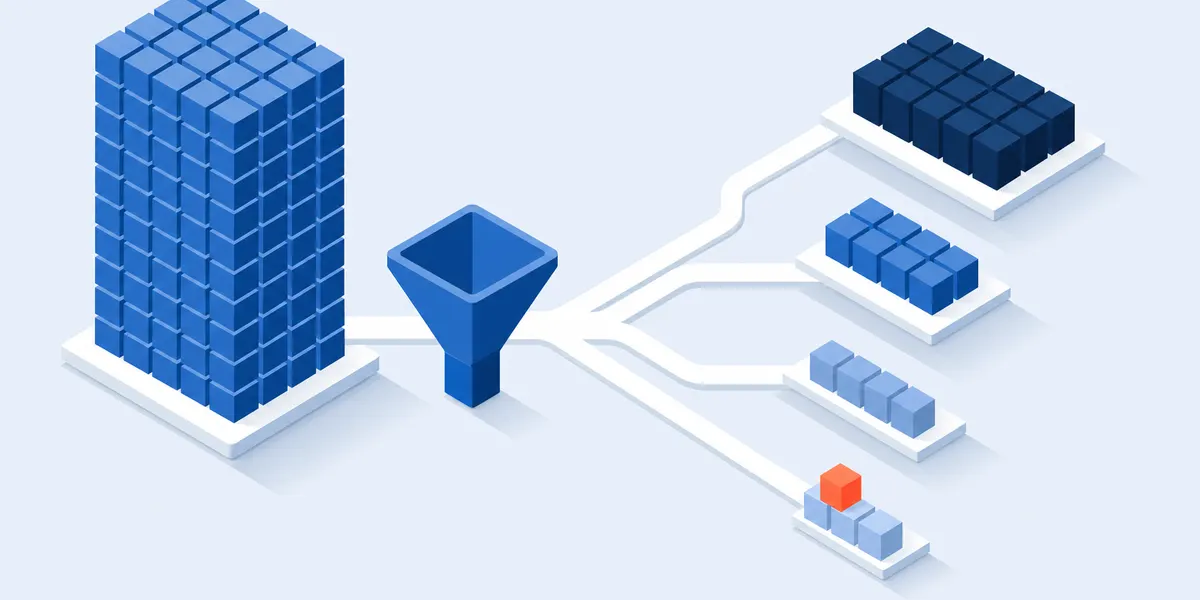
A tall stack of identical small blocks on the left sorted through a funnel into four separate groups of different sizes on the right, with one block picked out in orange
The output is groups, not a score. Everything on the page is built so the groups are countable.

Turning the answers into profiles

Four steps, none needing a statistician. The first is the one people skip.

  1. Split on question 1 first, ahead of everything else

    A household buyer, a business buyer and somebody buying for a third party answer questions 7 to 13 differently, and averaging them produces a customer who does not exist. If one group is tiny, set it aside.

  2. Cross-tab, do not average

    Fourteen answers are categories, so there is no mean to take. The readings worth having are pairs: trigger by tenure, channel by age band, spend by buying unit. Start with three you chose before it went out.

  3. Read the open box before you name anything

    Question 4 is the only place people use their own words. Read fifty end to end and you have the vocabulary for the next wave, and often a trigger that is not among the five options in question 5.

  4. Write each profile as a sentence you could be wrong about

    "Our second largest group buys once a year, after something breaks, and finds us through a search engine" can be checked against the next wave. "Busy professionals who value quality" cannot, and it will survive any evidence.

Run it again before the answers age. Same wording, fresh sample, once a planning cycle: a changed option list ends the comparison. For the market beyond your own list you need a different sample and a different instrument, and the marketing survey templates by use case page has the rest.

Questions people ask about profiling surveys

What is the difference between a customer profile and a buyer persona?

A profile is what the answers say. A persona is what somebody writes afterwards, as one named character with a photograph and a job title. This survey produces the first; the second is a summary you write from it. Reverse the order and two things go wrong: a persona written first decides which questions get asked, and one written from a single answer describes one customer, not a group.

How many answers do I need before the profiles mean anything?

It depends on how far you intend to split the results, which you can decide before you send. Every useful reading here is a cross-tab: buyer type by channel, trigger by tenure, spend by age band. Pick the splits you care about, decide the smallest group you would act on, and run the survey until the smallest reaches it. No threshold comes with the instrument. What does is a rule: never name a profile from a group so small you could list its members.

Can a customer profile survey be anonymous?

Not really, and it is better to say so than to promise it. A profiling survey collects the fields that identify people: on 2000 US census data, gender with a ZIP code and a full date of birth uniquely identified 63.3 percent of Americans.[1] The fifteen above stay as far from that as they can and still be useful, which is why they carry an age band and a country. What you can honestly offer is one line at the top saying who will read the answers and why. Leave the name and email fields off as well and no single answer names a person. That is a smaller promise than anonymity, and one you can keep.

Should the questions about the person go first or last?

The evidence is mixed, and it is not the decision that matters. What has been tested is whether asking them at all costs you responses, and in a randomised trial of 4,448 mailed questionnaires it did not: 34.2 percent responded when they were left out, 33.0 percent when included, 33.1 percent on a separate sheet.[2] The same trial found they were answered more often inside the survey than on a sheet of their own, 32.7 against 28.3 percent.[2] So keep them on the form. They are last here because question 4 is worth more while attention is fresh.

Do I have to ask about income?

No, and it is the question people decline most. In a study of 99 people recruited through food banks and community programmes, 35.2 percent said they would leave a household income question blank, against 18.5 percent for race and 5.6 percent for age. One line explaining why it was asked cut the income refusals to 20 percent.[3] That is a small sample in one city, but the ordering is a useful warning: if you ask, say why, and if what you wanted was value rather than income, question 9 asks it directly.

Methods and sources

What this template is based on

The precision rule behind questions 14 and 15 comes from a re-computation of uniqueness on the 2000 US census.[1] The placement advice comes from two studies of these items in mailed questionnaires.[2][3] All fifteen questions are written for this page.

Question licensing

No published instrument is reproduced here. The seven race and ethnicity categories in the copy block are the minimum reporting categories of a US federal standard, a work of the United States government.[4] Everything else here is yours.

Limits and disclosure

The uniqueness figures are computed on the 2000 US census; the ordering holds elsewhere but the percentages do not transfer.[1] The refusal figures come from 99 people in one city.[3] The response-rate trial used mailed paper, not links.[2] No figure here comes from SuperSurvey.

SuperSurvey makes the editor this template opens in. The questions are free to copy, edit and translate with or without it.

References

  1. Golle, P. "Revisiting the Uniqueness of Simple Demographics in the US Population." Proceedings of the 5th ACM Workshop on Privacy in the Electronic Society (WPES 06), Alexandria, Virginia, 30 October 2006, pages 77-80. Computed on the 2000 US census. dl.acm.org
  2. Ziegenfuss, J. Y., Easterday, C. A., Dinh, J. M., JaKa, M. M., Kottke, T. E. and Canterbury, M. "Impact of Demographic Survey Questions on Response Rate and Measurement: A Randomized Experiment." Survey Practice 14(1), 2021. 4,448 people randomised across three versions of a mailed questionnaire. surveypractice.org
  3. Lor, M., Bowers, B. J., Krupp, A. and Jacobson, N. "Tailored Explanation: A Strategy to Minimize Nonresponse in Demographic Items Among Low-income Racial and Ethnic Minorities." Survey Practice 10(3), 31 May 2017. 99 participants recruited through food banks and community programmes in Madison, Wisconsin. pmc.ncbi.nlm.nih.gov
  4. Orvis, K., Chief Statistician of the United States. "OMB Publishes Revisions to Statistical Policy Directive No. 15," Office of Management and Budget, 28 March 2024. Sets one combined race and ethnicity question and seven minimum reporting categories for US federal data. spd15revision.gov
  5. Regulation (EU) 2016/679 (General Data Protection Regulation), Article 9(1), which names data revealing racial or ethnic origin, political opinions, religious or philosophical beliefs, trade union membership, genetic data, biometric data, health data and data concerning sex life or sexual orientation. gdpr-info.eu

Send the fifteen and find out who is actually buying

Fifteen questions, about four minutes, free to copy or edit.

Use this template