View/Export Results
Manage Existing Surveys
Create/Copy Multiple Surveys
Collaborate with Team Members
Sign inSign in with Facebook
Sign inSign in with Google

Pre event survey questions for people who have not arrived yet

A nine-question survey for the people who registered and have not turned up yet. Every item feeds a decision that closes before the doors open: the programme, the room, the access support and the catering order. Answer it here first, then send your own.

  • 9questions
  • about 3 minto complete
  • Beforenot after the event
  • Every itemprinted with its answer options
Pre-Event Survey · answer to move through it
Use this template
Question 1 of 9 What to put on
What do you most want to get out of this event?
Learn something specific I can use straight away
Meet people who do what I do
Hear from the speakers
Find tools, suppliers or services
Represent my team or organisation
I am not sure yet
Question 2 of 9 What to put on
Which of these would you make time for?
Talks from the main stage
Hands-on workshops
Small-group or roundtable discussion
Questions and answers with the speakers
Structured networking with introductions
Unstructured time to talk to whoever I want
A quiet space to work or rest
Question 3 of 9 What to put on
How much do you already know about the main subject?
This is new to me
I know the basics
I work with it regularly
I could teach it
Question 4 of 9 What to put on
What would make this event worth your time?
Question 5 of 9 Who to plan for
How much of the event do you expect to be there for?
All of it
Part of it, and I know which part
I will drop in if I can
I am not sure I will make it
Question 6 of 9 Who to plan for
Do you need anything from us in order to take part?
Live captioning
A sign language interpreter
Step-free access to the room and the facilities
A seat near the front, or near an exit
Materials in advance, or in large print
A quiet space to use during breaks
Something else
Nothing, thank you
Question 7 of 9 Who to plan for
Is there anything else we should know so you can take part fully?
Question 8 of 9 What to order
If food is served, do you have an allergy to any of these?
Milk
Eggs
Fish
Crustacean shellfish
Tree nuts
Peanuts
Wheat
Soybeans
Sesame
Something else not on this list
No food allergies
Question 9 of 9 What to order
Which of these describes what you eat?
No restrictions
Vegetarian
Vegan
Halal
Kosher
Something else

What you can ask before an event, and what you cannot

Every other survey in this family is sent after something happened. This one is sent before, and that changes all three parts of it.

There is no experience to rate yet. Nobody can tell you how the keynote went, whether the room was too cold or how likely they are to recommend the day, because none of it has happened. Every item in the template asks about an expectation, an intention or a need, and there is no rating scale anywhere in the nine. A rating needs something that already exists.

The people you can reach are registrants, not attendees. Some of them will not come. That is the population, not a flaw in the survey: a list of people who have said they intend to be somewhere. Question 5 asks how much of the event they expect to be there for and offers "I am not sure I will make it" as an answer, so the count you plan around is the one they gave you rather than the one on the registration list.

It shapes the event rather than judging it. An answer is worth collecting only while the decision it feeds is still open. Once the caterer has the numbers and the interpreter is booked, an answer about food or captioning changes nothing at all. When the event is over and the question becomes how it went, the event feedback survey questions are the set to send instead.

Two other surveys look like this one and are not. A sprint retrospective also goes out before its meeting, but its items ask about a sprint that has finished, so it is a past-tense instrument delivered early; that is what the agile retrospective survey covers. A training baseline is genuinely future-tense, and it exists to be asked again afterwards so the two sets can be compared. This one is never re-asked. It is a single input to four decisions that close before the doors open.

One sentence for anyone who wanted a form. If what you need is the internal request that books an event, with venue type, headcount, budget line and billing address on it, that is a planning intake form rather than a survey. So is the questionnaire a planner sends to the client who is paying. Both are documents about the event; this is a survey of the people invited to it.

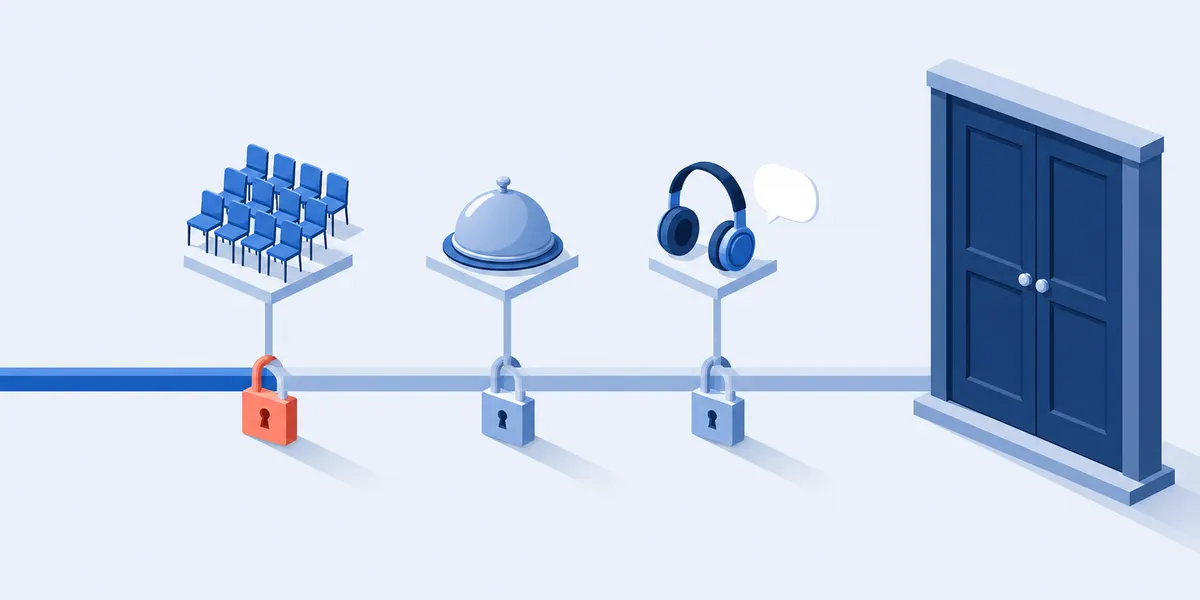
Diagram of a pre-event timeline: a rail running left to right toward a closed door, with the room set, the catering order and the access booking each locked onto the rail at its own earlier point
Four decisions, four different last-changeable dates, all of them before the door opens.

The nine pre event survey questions

Every item with its answer options and what to do with the answers. Copy one block or the whole set.

Plain text, one question per line, with the answer scale.

What to put on

Four items that change the programme, the format and the level it is pitched at. Ask them while the running order is still a draft.

  1. What do you most want to get out of this event?Pick one of 6Count the answers by option and set the running order against them. A split between learning and meeting people is a programme that has to do both, not a tie to break.
  2. Which of these would you make time for?Tick all that applyA format almost nobody ticks is one to cut before you book a room for it. Swap the seven options for the formats you can actually put on.
  3. How much do you already know about the main subject?Pick one of 4Brief the speakers with this distribution instead of your own guess. Pitch the opening session at the second band and give the fourth band somewhere else to be.
  4. What would make this event worth your time?Short text, optionalRead these as a list rather than counting them. It is the only item where somebody can raise a thing you did not think to ask about.

Who to plan for

Everyone answering is a registrant, not an attendee. These three ask how much of it they expect to attend and what they need from you in order to attend any of it.

  1. How much of the event do you expect to be there for?Pick one of 4A planning number for chairs, badges and catering counts. It is not a verdict on the event and it should not be reported as one.
  2. Do you need anything from us in order to take part?Tick all that applyAct on each response on its own. One person needing captioning is a booking to make, and a majority not needing it changes nothing about that booking.
  3. Is there anything else we should know so you can take part fully?Short text, optionalThe open channel for a request that no checkbox fits, food included. Print an email address beside it for anyone who would rather not type it into a form.

What to order

Two items rather than one, kept apart on purpose: an allergy is a safety matter for the kitchen and a diet is a menu choice, and a single merged list buries the first inside the second.

  1. If food is served, do you have an allergy to any of these?Tick all that apply Option list: the nine major food allergens, FDA[4]Hand the counts to the caterer as they stand. Keep the open option: the nine are the labelled list, not every allergy a guest can have.
  2. Which of these describes what you eat?Pick one of 6A menu count, and nothing to do with safety. If you are serving a set menu this is the item that decides how many of each.

Three swaps before you send. Replace the seven formats in question 2 with the ones you can actually put on, and drop the rest. If you are not serving food, cut questions 8 and 9 rather than leaving them in as filler. And if the answers have to be attached to a person, add the registration name or email as question 1 and say why in the invitation, which is the next section.

Send it while the answer can still change

The standard advice is a number of weeks. The version that survives contact with a real event is a date per decision, and you already know all four dates.

Write your own dates into the right-hand column before you send anything. Whichever is earliest is the day the survey has to close, and that is the date to print inside the survey rather than only in your own calendar.

What you are collectingThe decision it feedsWhat sets the date
Questions 6 and 7, what people need in order to take partCaptioning, interpreters, step-free routes, seating, materials in advanceWhoever supplies them. The University of Colorado Boulder asks for two weeks for adjustments in general and seven days for interpreting and captioning, and says a request arriving less than five business days before an event may not be met.[3] Ask your own supplier and print the answer.
Questions 8 and 9, foodThe catering order and the set menuThe final numbers date in your caterer's contract.
Questions 1 to 4, what people want and how much they knowThe session list, the running order, the level to pitch at, the speaker briefsThe day you have to publish the programme or brief the speakers, whichever comes sooner.
Question 5, how much of it people expect to attendRoom layout, chair count, badges, how much of each thing to orderThe day the room set is locked with the venue.

Ask about access before the event, or do not ask at all. This is the one item on the page that is worthless if it arrives late, and it is the reason a pre-event survey exists at all rather than being folded into the one sent afterwards. Federal guidance on running accessible meetings puts it plainly for the agencies it covers: a meeting invitation should always include a means to request accommodations.[1] That is good practice to copy rather than a duty on a private event, and the survey is one clean way to carry it.

There is no standard deadline to copy, so publish yours. Three sources give three different figures and the national guidance gives none, saying only that materials should carry a reasonable deadline.[2] Pick the one your own suppliers need, write it into the invitation and into question 7's helper text, and hold to it.

Sending it when you do not run the registration

This survey is a link. It does not read your ticketing system, and that turns out to decide the most important thing about it.

Paste it into the email you are already sending. The registration confirmation, the reminder, the joining instructions. It can also sit on the event page as an embed or go out as a plain link. There is no ticketing, event-platform, webinar or CRM connection behind it, so nothing here knows who registered, which ticket they hold or whether they turned up on the day.

Which means you have to decide, up front, whether an answer belongs to a person. A response that arrives without a ticket record attached is either anonymous or it carries an identifier you asked for. There is no third option, and the two make different surveys.

Which survey you are sendingWhat to addWhat to say in the invitation
The answers are for one named person: a seat, a meal, an interpreter, a room they can reachThe registration name or the email address as question 1, and nothing else identifyingThat it cannot be anonymous, who will read it, and what the answers are used for
The answers only shape what you build: topics, level, format, how longNothing identifying at allThat there is no name field and no email field, so nobody is going to be chased about it

Mixing the two is the mistake worth naming. A survey that opens with name, email, age and occupation and then asks which topics somebody likes is a registration form and an agenda poll at the same time, and the person answering cannot tell which one they are filling in. If you do need identifying items, put them last rather than first, and see demographic questions and where to put them before you write them.

All nine questions are already loaded into the build a survey editor, so the only work left is your own event name, your own formats and your own closing date.

Do not collect an access need you have no plan to meet. Question 6 invites somebody to say they need captioning or a step-free route. If the answer goes into a spreadsheet and nothing follows, you have made a promise in public and broken it in private, and that is worse than never having asked.

What to put in front of people before question one

Before you start

This survey is about [event name] on [date], which has not happened yet. It asks what you want out of it, how much of it you expect to attend, what you need in order to take part, and what you eat. There is nothing to rate.

Nine questions, about three minutes.

Please answer by [date]. After that the room, the access support and the catering are booked, and we will not be able to act on what you tell us.

We do not ask for your name or your email address, so an answer cannot be traced back to you. [NAME] owns this survey and can open every response.

If you need an adjustment and would rather not put it in a form, email [NAME] at [ADDRESS] instead.

What comes back, and what to do with it

Half of this survey is counted and half of it is acted on one row at a time. Reading the two halves the same way is how the access answers get lost.

Questions 1 to 5 are counts. Put them in order of size and set the programme against them. Do not weight them, do not convert them into a percentage of everyone who registered, and do not treat a small set of answers as a mandate: they are the only signal you have about what people want, and the alternative you are comparing them against is your own guess.

Questions 6 to 9 are a list of individual requests. An access need and an allergy are not proportions. One person needing an interpreter is a booking to make, and the ninety-five per cent who need nothing do not outvote them. Work down that list one row at a time, mark each one done, and hand the allergy counts to the caterer as they stand.

Expect a small number of answers and design for that. The people you are writing to have not turned up yet and have no relationship with the event beyond a registration. One agency, Drive Research, published the numbers for a single project of its own: a 24-question pre-event survey, four minutes on average, 35 responses at a 5 per cent response rate.[5] That is one client and one event rather than a benchmark, and the useful part is the size, not the percentage. Nine questions that thirty-five people can answer will change more about your event than forty that nobody finishes.

If the event is one thing your members get among many, and the real question is what the membership wants across a whole year, the member survey questions ask that instead.

Pre-event survey FAQ

What questions should you ask in a pre-event survey?

Four things you can still act on: what people want out of the event, which formats they would make time for, how much they already know about the subject, and what they need from you in order to take part. Add food if you are catering. Leave out anything you cannot change by the time the answers arrive, and leave out every rating item, because at this point there is nothing to rate.

How many questions should a pre-event survey have?

Nine, at about three minutes. One agency, Drive Research, published the numbers for a single project of its own: a 24-question pre-event survey, four minutes on average, 35 responses, a 5 per cent response rate.[5] That is one event and one client rather than a benchmark, but it is the size of thing to design for. Write questions that are still worth acting on when thirty-five people answer, then stop.

When should you send a pre-event survey?

Work back from the decisions rather than from a fixed number of weeks. Each answer feeds something with a last-changeable date: the programme, the room set, the access bookings, the catering numbers. Send the survey so the earliest of those dates is still ahead of you, and print that date inside the survey. The ADA National Network guide to temporary events asks for exactly that on registration materials, contact details and a reasonable deadline for requesting communication services, and stops short of naming a figure.[2]

What are some sample survey questions for event planning?

The nine on this page are the set, printed with their answer options so they can be copied out whole. One warning about the phrase: a second document goes by a similar name, the intake form a planner sends to the client who is paying, with venue type, headcount, budget line and billing address on it. That is a form for scoping a job rather than a survey of the people invited, and nothing here will fill it in.

Is a pre-event survey the same as a post-event survey?

No, and the difference is not the wording. A survey sent afterwards asks about an experience that already exists. This one asks about expectations, needs and intentions, from a list of people who registered and might not come. It is also asked once and never repeated, which is what separates it from a training baseline: a baseline exists to be asked again afterwards so the two sets can be compared, and that is what the survey before a training session is for.

Methods and sources

What this template is based on

Nine questions grouped by the decision each one feeds: what to put on, who to plan for, and what to order. There is no rating item, because at the moment this survey is sent there is nothing yet to rate. The access item is asked before the event rather than after it because federal guidance on accessible meetings says an invitation should always carry a means to request accommodations,[1] and an adjustment requested once the event is over cannot be provided. Allergy and diet are two separate items because one is a safety matter for the kitchen and the other is a menu choice.

Question licensing

No published pre-event instrument exists to license: there is no validated scale for this subject, no proprietary questionnaire and no author to credit, so all nine questions were written for this page. The option list in question 8 is the statutory United States allergen list published by the Food and Drug Administration, reproduced as a list of names.[4]

Limits and disclosure

The two named lead times belong to one university and are its own policy rather than a standard.[3] The federal guidance cited addresses federal agencies running federal meetings, so it is good practice to copy on a private event and not a duty.[1] The nine allergens are the United States list; the European Union names fourteen, and other jurisdictions differ again. The one measured response figure available on this subject is a single agency reporting a single client project at n=35.[5] The survey carries no score: it produces counts on five items and a list of individual requests on four, and there is nothing here to add up.

SuperSurvey builds the editor this template opens in. Nothing here depends on using it.

References

  1. U.S. General Services Administration. "Accessible Meetings." Section508.gov, reviewed July 2026. section508.gov
  2. ADA National Network. A Planning Guide for Making Temporary Events Accessible to People with Disabilities. 2015. adata.org
  3. University of Colorado Boulder, Digital Accessibility Office. "Accessible In-Person Events." colorado.edu
  4. U.S. Food and Drug Administration. "The FASTER Act: Sesame Is the Ninth Major Food Allergen." Last updated 12 April 2024. fda.gov
  5. Ridley, Janna. "Pre-Event Surveys: Example Questions + a Real Case Study." Drive Research, 18 April 2025. driveresearch.com

Send it while you can still act on the answers

Nine questions, about three minutes, and a closing date set by the earliest decision it feeds. Put your own event name and formats in and send it.

Use this template