View/Export Results
Manage Existing Surveys
Create/Copy Multiple Surveys
Collaborate with Team Members
Sign inSign in with Facebook
Sign inSign in with Google

Restaurant Survey Questions and Template

Twelve questions a diner answers in about two minutes, on a table card, a receipt link, a takeout bag or an email. Take it here first, then open it in the editor and send it tonight.

  • 12questions
  • About 2 minto complete
  • 4 channelsone instrument
  • Question 1names who answered
Restaurant Survey · answer to move through it
Use this template
Question 1 of 12 Which channel
How did you get your food from us this time?
I ate in the dining room
I collected a takeout order
It was delivered to me
I used the drive-thru
Something else
Question 2 of 12 How often
How often do you order from us?
This is my first time
Once or twice before
Every month or so
Most weeks
Question 3 of 12 The whole order
Overall, how satisfied were you with your order this time?
1
2
3
4
5
Very dissatisfiedVery satisfied
Question 4 of 12 The food
How satisfied were you with the food itself?
1
2
3
4
5
Very dissatisfiedVery satisfied
Question 5 of 12 The wait
How satisfied were you with how long you waited?
1
2
3
4
5
Very dissatisfiedVery satisfied
Question 6 of 12 Value
How satisfied were you with what you got for the price?
1
2
3
4
5
Very dissatisfiedVery satisfied
Question 7 of 12 Accuracy
Was everything you ordered correct?
Yes, all of it
No, and it was put right
No, and it was not put right
Question 8 of 12 Only if someone served you
How satisfied were you with the people who served you?
1
2
3
4
5
Very dissatisfiedVery satisfied
Question 9 of 12 Only if you want a reply
If you want someone to come back to you about this, leave an email or a phone number.
Question 10 of 12 Your words
What is the one thing that would have made this better?
Question 11 of 12 Your words
What should we not change?
Question 12 of 12 Coming back
Would you order from us again?
1
2
3
4
5
Definitely notDefinitely

The 12 restaurant survey questions, and what each one is for

Every question, the scale it uses, and what a low answer is pointing at. Copy one block, copy the lot, or open the whole thing in the editor.

Plain text, one question per line, with the answer scale.

Who answered, and how they bought

Two questions that say which slice of your customers you are reading. Without them every number below is an average of unknown parts.

  1. How did you get your food from us this time?Choose one of fiveSplit every other answer by this before you read any of them: a drive-thru rating and a dining-room rating are not the same measurement.
  2. How often do you order from us?Choose one of fourRegulars or strangers. A survey only regulars answer describes the people you already kept.

The four ratings every channel can answer

One judgement each on the four things any diner can rate, whether they sat down, collected a bag or opened a door.

  1. Overall, how satisfied were you with your order this time?1 to 5 satisfactionThe headline. Read it inside each channel, never across all four at once.
  2. How satisfied were you with the food itself?1 to 5 satisfactionThe food as a whole. Grading it dish by dish is a different survey and a much longer one.
  3. How satisfied were you with how long you waited?1 to 5 satisfactionOne wait, whichever one mattered to them. Splitting it into the wait for a table and then for the food asks two things in one box.
  4. How satisfied were you with what you got for the price?1 to 5 satisfactionLow here while the food and the wait score well points at the price, not at the kitchen.

What went wrong, and how to reach them

A wrong order is a different problem from a slow one, and the contact line is the only place a diner can stop being anonymous.

  1. Was everything you ordered correct?Choose one of threeThree answers, three jobs. Only the third is a list somebody works through in the morning.
  2. How satisfied were you with the people who served you?1 to 5 satisfaction optionalOptional, because a drive-thru or a marketplace order may have involved nobody at all. Forcing it puts a made-up number next to a named shift.
  3. If you want someone to come back to you about this, leave an email or a phone number.Short text, optional the only identity questionBefore the open boxes, not after. A diner who wants a reply leaves it; one who does not still finishes.

Their own words, then the closing rating

Two open boxes while the meal is fresh, then one rating to end on.

  1. What is the one thing that would have made this better?Long text, optionalOne thing, not a list. Short answers are the ones a manager reads between services.
  2. What should we not change?Long text, optionalStops a menu change removing the dish people came back for.
  3. Would you order from us again?1 to 5, definitely not to definitelyA return question, not a recommend question: coming back is the thing one restaurant can act on.

Swap-in items for the room, the counter and the app

Add the block matching the channel you are asking through, and take out anything that diner could not have seen.

  1. How satisfied were you with how clean the dining room was?1 to 5 satisfaction dining roomOnly ask somebody who was in the building. Printed on a takeout bag it collects guesses.
  2. How satisfied were you with the noise level?1 to 5 satisfaction dining roomA room-level answer the food and service ratings cannot carry.
  3. Was your table ready when you arrived?Choose one: yes, a short wait, a long wait dining roomSeparates a booking problem from a kitchen problem.
  4. Was your order ready when we said it would be?Choose one: yes, early, late collected takeoutMeasure against the time you promised, not against a clock.
  5. How satisfied were you with the way your order was packed?1 to 5 satisfaction collected takeoutFor an order carried home by the buyer. If a courier carried it, packing belongs with the courier questions.
  6. How satisfied were you with the website or app you ordered through?1 to 5 satisfaction ordered onlineOrdering is part of the meal when the meal starts on a phone.

Editing it. All 12 are already loaded, so change a stem, drop the swap-ins you do not need and send it tonight from the free online survey editor. Keep question one whatever else you change: without it the other eleven are one average of four different populations.

What is deliberately missing. No age band, no gender and no marital status: none of the three changes what a manager does tomorrow. There is no 0 to 10 recommend item either, because that one has its own arithmetic and lives with the NPS survey questions. And nothing here grades the menu dish by dish, which is what the meal satisfaction survey questions are for.

Who answers a restaurant survey, and who never does

A hotel has your email before you arrive. A delivery app already knows who you are. A restaurant can serve a full room and learn not one name, so the channel you ask through decides who you hear from.

How you askWho it reachesWho it cannot reachWhat the answers are good for
A card on the table, or a code with the checkPeople still sitting in your dining room, while the meal is in front of them.Everybody who took the food away, and anybody who left before the check arrived.The shift, the section and the dish, tonight.
A link printed on the receiptWhoever paid, which is one person per table however many ate.The rest of the party, and anybody who paid cash and took no receipt.The order, not the table.
An email or a text after the visitDiners who already gave you an address: a booking, a loyalty account, an app login.Walk-ins, who by definition gave you nothing to write to.Repeat customers, read as repeat customers and nothing more.
A code on the takeout bag or the drive-thru receiptThe off-premise orders no table card can reach.Marketplace orders, if the marketplace keeps the customer details.Packing, accuracy and the wait: what goes wrong off premises.

The biggest group is the one no table card can see. The National Restaurant Association reported in 2025 that nearly 75 per cent of restaurant traffic now happens off premises.[1] That is a US industry figure and not yours: a wine bar with no takeout counter sits on one side of it, a chicken shop with a hatch on the other. Work your own share out of your own till before you decide where the code goes.

If marketplace orders are a large part of what you sell, the courier and the packaging are part of what the diner is rating and no table card reaches either, so the food delivery survey asks about the drop-off instead.

One restaurant, or several kinds of place? If you also run rooms, treatment chairs or a venue and want one instrument that compares across them, the guest feedback survey is built for that comparison.

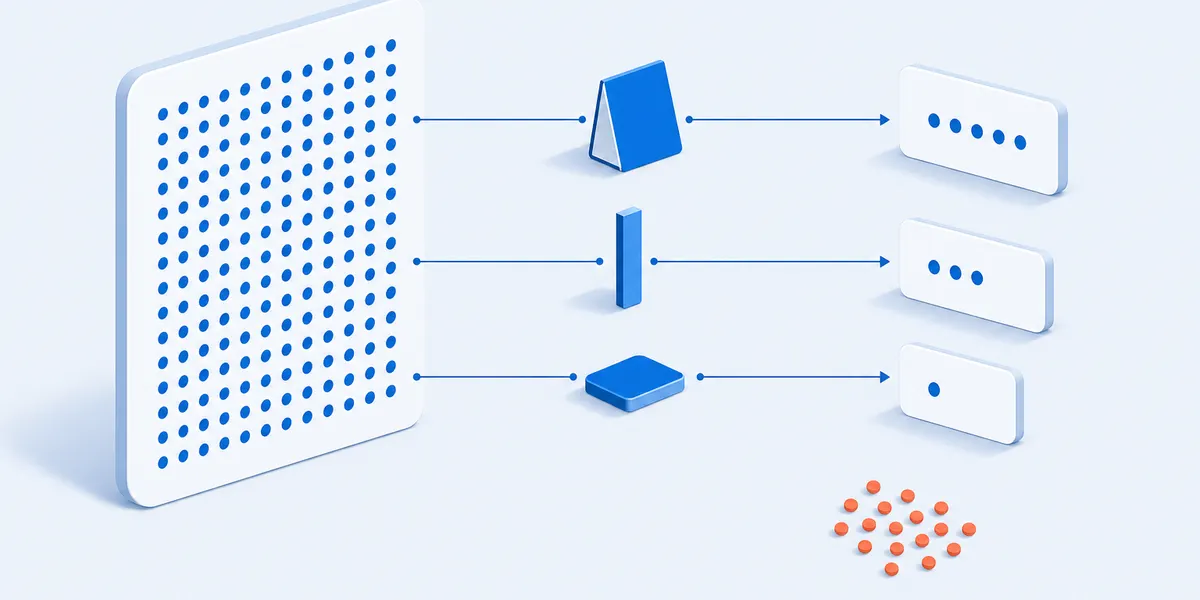
Three narrow channels each reaching a different small share of one large group of restaurant customers, with one group reached by none of them
A table card, a receipt link and a post-visit email are three different samples of the same night. The off-premise orders sit outside all three.

Your survey is not your reviews

The two sets of answers come from different people and do different jobs, and what you are allowed to offer is different too.

Reviews are a sample you do not control. The economist whose paper found that a one star change in a Yelp rating moves revenue at independent restaurants described those same reviews as reflecting "the views of a non-representative sample of consumers".[3] Both halves matter: the ratings are worth money and they are not a measurement of your dining room. Your survey is the measurement, and it changes nothing on the public page.

What you may offer, and to whom. The FTC's guidance on its Consumer Reviews and Testimonials Rule says the rule does not prohibit giving incentives for reviews, so long as nothing in the ask implies the answers have to express a particular sentiment.[4] A free dessert for finishing your own survey is fine on that reading. Attaching the same dessert to a Google review is not: Google's content policy for Maps prohibits offering incentives in exchange for posting one.[5]

Do not sort diners by how they answered. Showing the review link only to people who scored you well is what that policy calls selectively soliciting positive reviews, and it prohibits that too.[5] The FTC's own answer is worth reading straight: its rule contains no specific prohibition on asking only the customers you think are happy.[4] The rule you would be breaking is Google's, and it binds any restaurant with a Google Business Profile.

Check what your feedback tool already does. If a five star answer is routed to your public listing and a one star answer to a private form, that fork is the thing the policy names. This template ends the same way for everybody: one closing screen, one review line, whatever they scored. Swap [LINK] for your own review URL.

What a restaurant survey cannot tell you

Three limits worth knowing before you read the first answers. One is a design choice; the other two are holes nothing on this page can fill.

The people who answer chose to answer. In a study of Amazon product reviews the ratings came out J-shaped, far more strong opinions than middling ones, and when the same researchers had every participant write a review the distribution came out roughly normal instead.[2] That is product reviews, not restaurants, and it is quoted for the mechanism rather than the setting: the shape of a voluntary feedback set can come from who chose to answer rather than from what happened.

Two groups are absent from every channel above. People who read the queue or the menu and left without ordering held no receipt and scanned no code. Regulars who quietly stopped coming are on no list either, because the month they stopped is the month they stopped appearing on one. Asking harder will not produce them.

One order, once. A diner who came three times leaves three answers you cannot join together unless they left a contact line, so this survey cannot watch one person's opinion change.

Which is what question one is for. It does not fix the sample; it names it, so the average you report is an average of something you can describe. If what you want instead is one satisfaction percentage worked through end to end, the customer satisfaction survey questions do that arithmetic.

Restaurant survey FAQ

How many restaurant survey questions should you ask?

This one has 12 and takes about two minutes. Twelve is a design choice, not a finding: nobody has published a number for this, so treat any recommendation with suspicion, ours included. It fits on a card read while waiting for the check.

When should you send a restaurant survey?

While the diner can still say which visit you mean. That is the argument for the table card and the code on the check: only one order is in play. An email two days later has to name the date and the dishes, or the answers rate the wrong night.

Can I offer a free dessert for filling in the survey?

For your own survey, yes on the FTC guidance, provided nothing in the ask implies the answers have to be positive. For a Google review, no: offering anything in exchange for one is on the prohibited list in Google's content policy for Maps.

Should a restaurant survey be anonymous?

Nothing asks for a name, and the contact line is the one place a diner can choose to identify themselves. Anyone who can open the account can read every answer, so word the ask that way and promise nothing beyond it.

How do I reach takeout and delivery customers?

Print the code on the bag, the lid or the drive-thru receipt as well as the table card, because none of those people will see a table card. If a marketplace took the order and kept the customer details, an insert in the bag may be the only channel you control.

What is a good restaurant survey score?

This page publishes no target. A score is built on your diners, your questions and your channel mix, and the mix is the part that moves. Compare month to month inside one channel, and read the splits before the average.

Methods and sources

What this template is based on

The four channels are the four ways a restaurant hands food to a customer, and the question order puts the channel first so every other answer can be read inside it. The rules on incentives and on sorting diners by their answers are the FTC's guidance on its Consumer Reviews and Testimonials Rule and Google's content policy for Maps.[4][5]

Question licensing

Nothing licensed is reproduced. No proprietary questionnaire sits behind this term and every stem is ordinary operating language, so the whole set can be copied, reworded and sent with no attribution to anybody.

Limits and disclosure

The off-premises share is a US industry figure from the sector's own trade association, reported with no sample size or field dates, so it is quoted as a reported figure and not as a study.[1] The review-distribution study is about product reviews on one retail site, not restaurants.[2] The Yelp paper covers one US state over a period ending well before today, and its revenue finding is for independent restaurants and explicitly not chains.[3] No target score is published here, because a restaurant score is built on your diners, your questions and your channel mix.

SuperSurvey makes the editor this template opens in. Everything on this page works with or without it.

References

  1. National Restaurant Association. From Trend to Transformation: Off-Premises Dining Now Essential for Restaurant Consumers, Operators. Press release, 16 April 2025, on the 2025 Off-Premises Restaurant Trends report. restaurant.org
  2. Hu, N., Pavlou, P.A. and Zhang, J. Why do Online Product Reviews have a J-shaped Distribution? Overcoming Biases in Online Word-of-Mouth Communication. Working paper, February 2007. archive.nyu.edu
  3. Luca, M. Reviews, Reputation, and Revenue: The Case of Yelp.com. Harvard Business School Working Paper 12-016. hbs.edu
  4. Federal Trade Commission. The Consumer Reviews and Testimonials Rule: Questions and Answers. Business guidance on 16 CFR Part 465, effective 21 October 2024. ftc.gov
  5. Google. Prohibited and restricted content. Maps user contributed content policy, Google Help. support.google.com

Put it on the table tonight

Twelve questions, about two minutes, and a first item that tells you which of your customers answered. Open it in the editor, add the block for your channel, and send one link.

Use this template