View/Export Results
Manage Existing Surveys
Create/Copy Multiple Surveys
Collaborate with Team Members
Sign inSign in with Facebook
Sign inSign in with Google

Taste Test Survey Template and Sensory Evaluation Form

Fourteen questions for one coded sample in front of one taster. Try it below, lift the questions, or open it in the editor and drop your own codes in. Look, smell, taste, texture, finish, then the decision.

  • 14questions
  • About 3 minper sample
  • 1 sampleper response
  • 5-pointliking scale
Taste Test Survey · answer to move through it
Use this template
Question 1 of 14 This sample
Which sample code is in front of you?
Question 2 of 14 This sample
Had you been told which product or recipe this sample is?
No, it was unlabelled
Yes, I was told
I was not told, but I think I recognised it
Question 3 of 14 The senses in order
How much do you like the way this sample looks?
1
2
3
4
5
Dislike a lotLike a lot
Question 4 of 14 The senses in order
How much do you like the smell of this sample?
1
2
3
4
5
Dislike a lotLike a lot
Question 5 of 14 The senses in order
How much do you like the flavour of this sample?
1
2
3
4
5
Dislike a lotLike a lot
Question 6 of 14 The senses in order
How much do you like the texture of this sample in your mouth?
1
2
3
4
5
Dislike a lotLike a lot
Question 7 of 14 The senses in order
How much do you like the taste it leaves behind?
1
2
3
4
5
Dislike a lotLike a lot
Question 8 of 14 Too little or too much
The sweetness of this sample is:
Much too little
Slightly too little
Just about right
Slightly too much
Much too much
Question 9 of 14 Too little or too much
The saltiness of this sample is:
Much too little
Slightly too little
Just about right
Slightly too much
Much too much
Question 10 of 14 Too little or too much
The strength of the flavour is:
Much too little
Slightly too little
Just about right
Slightly too much
Much too much
Question 11 of 14 In their words
In your own words, what did you taste first?
Question 12 of 14 In their words
Was there anything about this sample you did not like?
Question 13 of 14 The decision
If this were on the shelf at a price you thought was fair, would you buy it?
Definitely would
Probably would
Might or might not
Probably would not
Definitely would not
Question 14 of 14 Closing rating
Taking everything together, how much do you like this sample?
1
2
3
4
5
Dislike a lotLike a lot

The 14 taste test survey questions

Every question, its answer scale, and what a poor answer is telling you. Copy one block, copy all 14, or open the survey in the editor.

Plain text, one question per line, with the answer scale.

Which sample, and did they know

Two questions before a single rating. The form cannot see which cup is in front of the taster or whether the label was showing, so both are asked rather than assumed.

  1. Which sample code is in front of you?Short textRequired, and required first. A rating with no code attached cannot be counted, and cannot be reconstructed later.
  2. Had you been told which product or recipe this sample is?Choose oneInformation given before tasting can move liking and the perception of individual attributes.[2] Keep it beside the ratings so a blind sitting is never averaged with a labelled one.

The five senses, in the order they arrive

Five liking items on one scale, in the order a taster meets a sample: seen, smelled, tasted, felt, finished. Splitting liking into five stops one overall number hiding which part is doing the work.

  1. How much do you like the way this sample looks?5-point, dislike a lot to like a lotAsked before anything is in the mouth, because it cannot be un-seen afterwards.
  2. How much do you like the smell of this sample?5-point, dislike a lot to like a lotThe item most taste test forms leave out, and the one that explains a low flavour score no ingredient change will fix.
  3. How much do you like the flavour of this sample?5-point, dislike a lot to like a lotThe headline item. Report it on its own, never merged into an average with the other four.
  4. How much do you like the texture of this sample in your mouth?5-point, dislike a lot to like a lotMouthfeel is where reformulations quietly fail: the flavour survives the change and the texture does not.
  5. How much do you like the taste it leaves behind?5-point, dislike a lot to like a lotThe finish is what a taster carries into the next sample, which is why it closes this block.

Too little, just right, or too much

Three diagnostics in the just-about-right format: a middle that means correct and two directions of wrong. They sit after the liking items so nobody is told what to notice first.

  1. The sweetness of this sample is:Choose one, much too little to much too muchRead the two ends, not the average. A sample split between much too sweet and much too little averages to just right and pleases nobody.
  2. The saltiness of this sample is:Choose one, much too little to much too muchSwap salt for whatever decides your category: acidity, bitterness, spice, carbonation. Keep the five options as they are.
  3. The strength of the flavour is:Choose one, much too little to much too muchOverall intensity, separate from any one taste. A sample can be correct on every attribute and still be flat.

In their words

Two open boxes while the sample is still in the mouth. Ratings tell you how much; only these tell you what.

  1. In your own words, what did you taste first?Short text, requiredThe first-impression descriptor, and the vocabulary your pack copy has to stand next to.
  2. Was there anything about this sample you did not like?Long text, optionalOptional on purpose: nobody should have to invent a complaint. When it fills up, that is the finding.

The decision, and the closing rating

One buying question that names no price, then one overall rating last, because a rating is a single tap and a fading palate can still give an honest one.

  1. If this were on the shelf at a price you thought was fair, would you buy it?Choose one, definitely would to definitely would notCount the top box alone and the top two together, say which you are quoting, and stop. It is intent, not a sale.
  2. Taking everything together, how much do you like this sample?5-point, dislike a lot to like a lotPut this under the five sensory items, never instead of them: one overall score cannot say which part of the sample earned it.

Two placeholders to replace before you send. Question 9 should name whichever attribute decides your category, and [YOUR ORGANISATION] appears in the first-screen text below. Question 1 needs no editing: [SAMPLE CODE] is typed by the taster. Change wording if you must, then leave it alone, because a changed word ends the comparison with your next batch.

One thing this survey refuses to ask. Several taste test forms ask a taster to rank the samples or name a favourite. Somebody holding one cup cannot answer that, and a form that asks it collects a guess. A ranking has to come from a sitting where every sample was tasted, in an order you controlled.

Blind or labelled, and why you cannot average the two

Two different studies that happen to use the same form, and which one you are running changes what the numbers mean.

Blind means the sample is judged and nothing else. The pack, the logo and the price are out of the room, and each cup carries a code instead of a name. What comes back is about the recipe, which is what you want when the question is whether a reformulation held up.

Labelled means the product is judged as people will meet it. A study of Italian consumers tasting the same products blind and then with their labels found that information affects the overall liking of products and consumers' perception of product-specific sensory attributes.[2] How much it matters depends on the product category, the sensory attribute and the type of information given.[2]

So run both, and keep them apart. The gap between a blind score and a labelled score is a finding about your brand, and it disappears the moment the two sets are added together. Question 2 records which sitting a response came from.

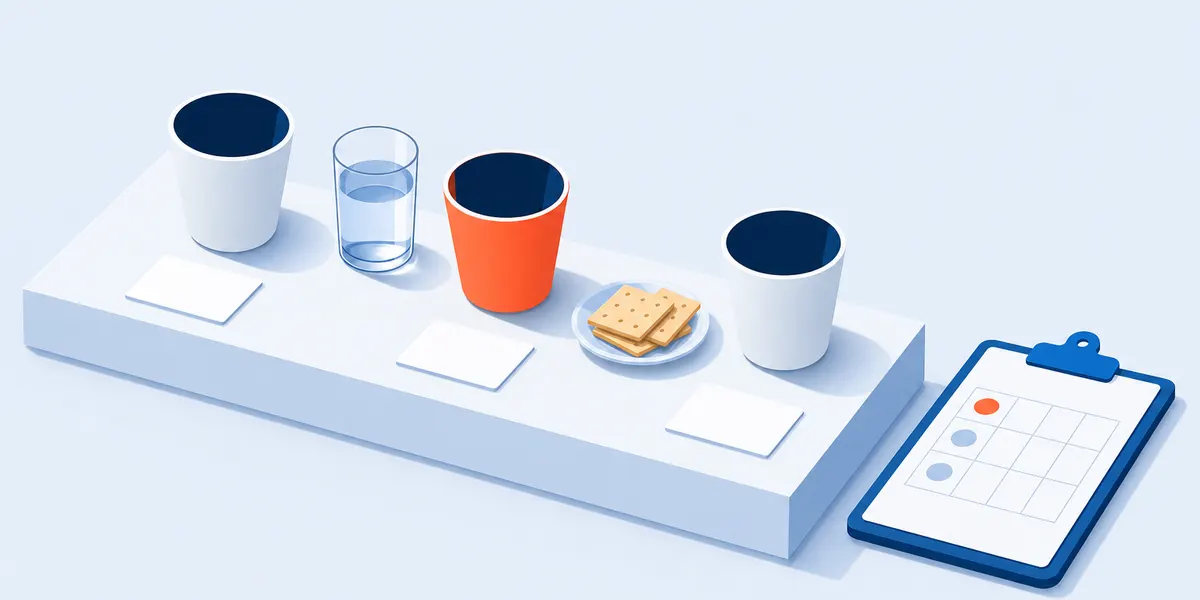
Three identical unbranded tasting cups in a row, each on a blank code card, with a glass of water and a plain cracker set between them
One coded sample, one taster, one response. The water and the cracker between samples are part of the method, not hospitality.
DecisionWhat it means in the roomWhat you can say afterwards
BlindThe label, the pack and the brand are out of sight, and the sample carries a code insteadHow the sample itself lands, with nothing attached to it
LabelledThe taster is told what they are drinking or eating before they taste itHow the sample lands as the product people will actually buy[2]
One sample per tasterEach person is handed one coded sample and that is the sittingHow each sample stands on its own, with no order effect to correct for
Several samples per tasterOne person works along a tray, cleansing between eachA comparison, but only if every sample gets a turn in first position[1]

Judging an idea that nobody can taste yet is a different job with a different instrument, and the questions here would have no honest answers: that is monadic testing. Once the product is on a shelf and somebody has lived with it, the sitting is over and you want product feedback survey questions instead. A whole meal, served by staff, in a room, is the restaurant feedback survey.

What the running order does to a taste test

The moment one person tastes more than one sample, the order stops being a detail and becomes part of the result.

Position moves the score. A study modelling carry-over in sensory acceptability tests reports that the last position had a significantly lower liking score compared to the first and center positions.[1] Nothing about the sample changed. The palate did.

The authors put it plainly: carryover effects cannot be ignored as they may lead to the misinterpretation of sensory acceptability results.[1] That is the argument for either one sample per taster or a deliberately balanced serving order.

Two ways out. Hand each taster one coded sample and the problem does not arise, at the price of a separate group for every sample. Or prepare as many running orders as you have samples, so every sample sits first for somebody: in that study each treatment appeared equally in each position, which achieved some mitigation of the order biases.[1]

Cleanse in between either way. The same experiment served water and unsalted crackers as palate neutralizers during the experiment.[1] It costs nothing and is the easiest part of the protocol to actually do.

What this sensory evaluation form cannot do for you

An online form is a good way to record what a person perceived. It is not a sensory laboratory, and a page that implies otherwise is selling you something.

What a proper sensory protocol asks forWhere it has to happenWhat this form does
Blind three-digit sample codesOn the cards and cups in the roomRecords the code the taster types into question 1
A rotated or balanced serving orderOn the trays, prepared before anyone sits downNothing. The form cannot see or change the order
Palate cleansing between samplesWater and a plain cracker on the table[1]Says so on the first screen and on the thank-you screen
A booth, controlled lighting, a fixed serving temperatureA sensory lab or a quiet room you set upNothing
A trained descriptive panel scoring intensityA different study entirely, with screened and trained assessorsNothing. This is a consumer liking form
Recording which sample each rating belongs toThe formQuestion 1, required, first

Everything physical happens in the room. This template does not randomise which sample a person is handed, because no form can. It assigns no blind codes, builds no serving order, enforces no rest and holds no temperature. All of that happens on the trays, and the form's only job is to bring each rating back attached to the right code.

It is not a triangle test. Discrimination testing asks whether people can tell two samples apart at all, a forced choice scored against a published table and formalised in ASTM E1885. This asks how much somebody likes what they have.

And it is not a trained descriptive panel. Screening and calibrating assessors to score intensity is its own discipline, with its own standard in ISO 8586, and it produces a description rather than a preference. This is a consumer liking form, already loaded in the free online form builder.

How to run the session

The instrument is the easy half. Most taste tests go wrong on the table, not in the form.

  1. Code every sample before anyone arrives

    Give each sample a code that says nothing: three digits, unrelated, different for every batch. Write it on the card the cup stands on. The taster types it into question 1, the only thread tying a rating back to a recipe.

  2. Decide blind or labelled, and do not mix them

    Pick one for the sitting and record which. For both, run two sittings with two sets of tasters, or the same tasters blind first and labelled later, never the other way round.

  3. Serve one sample at a time, in an order you wrote down

    If a person tastes more than one, give each group a different running order so every sample gets first place. Hand over one cup, wait for the form to be submitted, then clear it before the next appears.

  4. Put water and plain crackers on the table

    A sip, a bite and about thirty seconds between samples: the cheapest correction available and the one most sittings skip.

  5. Fix the taster count before you pour

    Decide how many people each sample gets while the cups are still empty, and give every sample the same figure. Closing a sitting early because one recipe looks good in front turns a tie into a finding that was never there.

One response per sample, not one per taster. Somebody tasting three samples fills the form in three times, once per code, so every row of data is attached to exactly one thing in one mouth.

First-screen text

Before you start

You are tasting one sample at a time. Each one carries a code on the card beside it. Type that code into the first question so your answers can be matched to the right sample.

Between samples, take a sip of water and a bite of a plain cracker, and wait about thirty seconds.

There are no right answers, and it takes about three minutes per sample. Your answers go to [YOUR ORGANISATION]. No name and no email address is collected anywhere in this form.

How to read the answers, sample by sample

Fourteen answers per sample, per taster. Read them in this order and the sample tells you what to change.

Split by code first, by question 2 second. Every summary is per sample code, and inside each code the blind and labelled responses stay in separate columns. Merged, they describe neither sitting.

Read the five sensory items separately. Averaging look, smell, flavour, texture and finish into one score is the fastest way to lose the finding: a sample liked for its flavour and rejected for its texture averages to something nobody experienced.

Read the just-about-right items from the ends inwards. Put the too little count beside the too much count: the middle is only good news when both ends are small, and a sample that divides the room averages to the middle and looks correct.

Then the open answers, before any chart. Question 11 gives you the words your pack copy has to live beside; question 12 names what no rating here points at. And two samples tasted by two separate groups means the gap between them holds the noise of both, so a narrow gap is a tie.

Taste test survey FAQ

What is a sensory evaluation form?

A form that records what one person perceives in one sample: how it looks, smells, tastes and feels, and how much they like each of those. This is the consumer version, which asks whether people like it. A trained descriptive panel does something different.

Should a taste test be blind or branded?

Run it blind when you want the sample judged, and labelled when you want to know what the label is worth. Do not mix the two in one set of numbers: information given before tasting has been shown to affect both overall liking and the perception of individual sensory attributes. Question 2 records which sitting each response came from.

How many samples can one person taste?

Fewer than you would like. Every sample after the first is judged by a palate the one before it has already changed. Cleanse between them, cap the sitting, and give different tasters different running orders.

Do I need a 9-point hedonic scale?

The nine-category liking scale developed by Peryam and Pilgrim in 1957 is the classic sensory instrument, and this editor does not offer it. A study comparing 9, 7, 5 and 3-category hedonic scales found the products came out in the same order of liking whichever scale was used. This template uses five categories with both ends written in words.

How many tasters do I need?

There is no honest single number, and the figures other pages print are power calculations dressed as facts. It depends on how small a difference you need to see. The arithmetic sits on the market research sample size template; decide the figure before you start pouring and use the same one for every sample.

Can this form randomise the order the samples are served in?

No. Nothing on a screen can control what a person is handed. Rotation happens in the room, on the trays, and the form records which sample was judged through the code in question 1.

Methods and sources

What this template is based on

The account of serving order, carry-over and palate cleansing follows a published study modelling carry-over effects in sensory acceptability tests[1]. The blind versus labelled argument follows a study of consumers tasting the same products with and without their labels[2]. The choice of a five-category liking scale rests on a comparison of 9, 7, 5 and 3-category hedonic scales, which reported the same order of liking whichever scale was used[3].

Question licensing

Nothing licensed appears, and that is deliberate. The nine-category hedonic scale developed by Peryam and Pilgrim in 1957 is named here and its nine verbal labels are not printed: no primary or openly licensed text setting out all nine could be verified, and easy access to a thing is not permission to reprint it. Its two ends and neutral middle are described on the authority of the open access papers cited above, which print them. ISO 11136, ISO 8586 and ASTM E1885 are sold rather than published, so all three are named and none is reproduced. Compusense and SIMS are named only. All 14 questions here are original and free to copy, edit, translate and redistribute.

Limits and disclosure

This is a consumer liking form, not a discrimination test and not a descriptive panel. It controls nothing that happens in the room: not the serving order, not the sample codes, not the rest between samples, not the temperature. No sample size is recommended, because that is a power calculation. No effect size is quoted from any cited study, so no magnitude is attached to a finding here. Tasted by people you invited, the answers describe those people and do not extend to a market.

SuperSurvey makes the editor this template opens in and sells no respondent panel and no tasting service, so the advice about recruiting and rotating your own tasters costs us nothing to give. The template is free either way.

References

  1. Torrico, D.D., Jirangrat, W., Wang, J., Chompreeda, P., Sriwattana, S. and Prinyawiwatkul, W. "Novel Modelling Approaches to Characterize and Quantify Carryover Effects on Sensory Acceptability." Foods 7, no. 11 (2018): 186. Open access, CC BY 4.0. doi.org
  2. Asioli, D., Wongprawmas, R., Pignatti, E. and Canavari, M. "Can information affect sensory perceptions? Evidence from a survey on Italian organic food consumers." AIMS Agriculture and Food 3, no. 3 (2018): 327-344. Open access, CC BY 4.0. doi.org
  3. Addo-Preko, E., Amissah, J.G.N. and Adjei, M.Y.B. "The relevance of the number of categories in the hedonic scale to the Ghanaian consumer in acceptance testing." Frontiers in Food Science and Technology 3 (2023): 1071216. Open access, CC BY. doi.org

Put a coded sample in front of somebody this week

Fourteen questions, about three minutes a sample, one sample per response. Code the cups and share one link.

Use this template